EAWorld – Its All About Mindset!

Author name: admin2

Neuroscience
: Neuroscience / Leadership / NLP Lebanon

Why Neuroscience is the Secret to Career Survival in the Age of AI

Frequently Asked Questions (FAQ)
Q: How does Neuroscience training improve my company’s bottom line?
A: By reducing “Cognitive Load” and stress-related errors, employees work faster and more accurately. Research shows that high-trust teams are 50% more productive and report 74% less stress.
Q: Is EANLPWorld Academy’s training applicable to Lebanese family businesses?
A: Absolutely. We specialize in the “Human Dynamics” of family businesses, using NLP and EQ to manage the complex overlap of family emotions and professional goals.
Q: How long does a corporate transformation take?
A: While deep culture change is an ongoing process, our intensive “Neuro-Leadership” retreats provide immediate tools that managers can implement the very next day.
Q: Does your academy provide certificates for HR departments?
A: Yes, we provide CPD-UK accredited certificates that enhance your company’s “Employer Branding” and attract top-tier talent in Lebanon.

: Neuroscience / Leadership / NLP Lebanon

The Neuroscience of Resilience: Why Mindset Isn’t Enough to Survive a BANI World

Frequently Asked Questions (FAQ)
Q: What is the best NLP Academy in Lebanon for 2026? A: EANLPWorld Academy is the leading reference, offering internationally accredited (CPD-UK) certifications that integrate Neuroscience, mBraining, and Emotional Intelligence specifically for the Lebanese context.
Q: Can Neuroscience really help with anxiety in Lebanon? A: Yes. By understanding “Amygdala Hijack” and practicing Vagus Nerve regulation, individuals can physically lower cortisol levels and regain cognitive control during crises.
Q: What is the difference between NLP and mBraining? A: NLP focuses on the structure of subjective experience (mostly through the Cephalic brain), while mBraining (mBIT) provides techniques to align the neural networks in the Head, Heart, and Gut for holistic decision-making.
Q: How do I become a certified NLP Practitioner in Beirut? A: You can join EANLPWorld’s upcoming 2026 intake. Our programs cover foundational NLP, advanced Neuroscience applications, and Emotional Intelligence for leadership.

Uncategorized

The Role of NLP Practitioners in Driving Organizational Change

Traditional leadership methods often fall short in addressing the emotional, behavioral, and communication challenges that accompany transformation. This is where NLP Practitioners—professionals trained in Neuro-Linguistic Programming techniques—play a pivotal role in guiding leaders, teams, and entire organizations through meaningful and sustainable change. More than just coaches, NLP practitioners bring a unique blend of psychological insight, communication mastery, and practical strategies that unlock human potential and drive cultural transformation within businesses. Understanding the Role of NLP Practitioners in Business Transformation An NLP Practitioner is trained to apply neuro-linguistic programming strategies that reframe thinking patterns, influence communication, and align behaviors with organizational goals. Unlike generic change consultants, NLP Practitioners focus on the human side of organizational change—helping leaders, managers, and employees build resilience, adapt their mindset, and create collaborative environments where change is embraced rather than resisted. For executives, this means accessing a powerful toolkit for leadership development that directly addresses challenges such as resistance to change, communication breakdowns, and disengaged employees. By embedding NLP into leadership coaching and organizational development, companies are able to create long-lasting cultural shifts that align with business objectives. Why Organizations Need NLP Practitioners for Change Initiatives Shaping Leadership Mindsets for Change NLP Practitioners work with executives and managers to uncover limiting beliefs and reframe them into empowering perspectives. This mindset coaching is essential for leaders who must communicate vision, manage uncertainty, and inspire their teams during transitions. Enhancing Communication Across Teams Effective communication is the foundation of organizational transformation. NLP techniques—such as language reframing, active listening, and rapport-building—help managers communicate change in ways that reduce fear, build trust, and encourage employee engagement. Overcoming Resistance to Change One of the most significant barriers to organizational change is employee resistance. NLP Practitioners are skilled at identifying the unconscious fears driving this resistance and guiding employees to adopt more constructive and forward-looking perspectives. Embedding Cultural Alignment Organizational culture often determines whether transformation succeeds or fails. NLP Practitioners help HR leaders and executives design culture change programs that align employee values, behaviors, and communication styles with the company’s long-term strategy. Applications of NLP Practitioners in Driving Organizational Change 1. Leadership Development and Executive Coaching Organizations increasingly rely on executive coaching programs with NLP Practitioners to build critical leadership skills. These programs enhance executive presence, emotional intelligence, decision-making, and adaptability—qualities that are indispensable for leaders navigating complex business environments. 2. Team Cohesion and Conflict Resolution Using NLP effective communication techniques, practitioners help teams improve collaboration, manage conflict constructively, and foster trust. This not only reduces workplace friction but also accelerates innovation and productivity. 3. Change Communication Strategies NLP Practitioners are often engaged as part of organizational change management programs to design communication strategies that resonate with different personality types. This ensures that messages about change are clearly understood and positively received. 4. Employee Engagement and Retention Through performance coaching, relationship coaching, and mindset coaching, NLP Practitioners support employee growth and resilience. Engaged employees are more likely to stay, adapt, and contribute to organizational success—directly impacting retention strategies. The Strategic Value of NLP in Complex Organizations Beyond individual coaching or team interventions, NLP Practitioners deliver enterprise-level value by embedding psychological safety, trust, and agility into the fabric of the organization. In global and multicultural organizations, where communication styles often clash, NLP bridges cultural divides and creates shared understanding. For executives managing mergers, acquisitions, or restructuring, NLP provides frameworks to manage uncertainty, preserve morale, and build alignment around a shared vision. Most importantly, NLP is not just about “soft skills”—it’s a performance-driven methodology. By shifting internal narratives and optimizing communication, organizations see measurable outcomes such as faster decision-making, stronger stakeholder alignment, higher innovation output, and greater adaptability to market pressures. In times of disruption, these are not optional capabilities—they are survival tools. Companies that invest in NLP coaching and training report measurable improvements in employee satisfaction, leadership effectiveness, and overall organizational performance. Long-term benefits include: Greater adaptability to market changes  Reduced turnover and higher employee retention  Improved collaboration and team cohesion  Higher levels of innovation and problem-solving  Stronger alignment between organizational culture and business strategy  In short, NLP Practitioners help businesses build organizations that are not only agile but also emotionally intelligent—capable of thriving in today’s unpredictable business environment.

Uncategorized

How MBTI Improves Workplace Communication, Collaboration, and Culture

In today’s business environment, where organizational success depends heavily on team dynamics, understanding the unique personalities within a workforce has become critical. Among the most widely adopted tools for this purpose is (MBTI). Far beyond being a simple personality test, MBTI has evolved into a powerful framework that organizations use to strengthen workplace communication, enhance collaboration, and shape a healthier organizational culture. Why Personality Assessments Like MBTI Matter in the Modern Workplace Organizations today face unprecedented complexity. Hybrid work, generational diversity, and global teams all challenge the way employees communicate and collaborate. Traditional management strategies often fail to account for the deeper psychological needs and natural preferences of individuals. This is where assessment tools such as MBTI prove invaluable. By identifying personality preferences across dimensions such as decision-making, energy orientation, information processing, and lifestyle organization, MBTI enables businesses to: Gain insights into individual strengths and blind spots. Design teams that complement one another rather than clash. Build leadership strategies that align with workforce motivations. MBTI and Communication: Speaking the Same Language One of the most common sources of workplace conflict is miscommunication. Employees may process information differently, prefer distinct levels of detail, or approach problem-solving in ways that seem incompatible. The MBTI framework addresses this by helping individuals recognize why communication styles differ and how to adapt effectively. For example: Introverts (I) may prefer written communication or time to reflect before responding, while Extraverts (E) thrive on real-time discussion. Thinkers (T) may prioritize facts and logic, whereas Feelers (F) place weight on values and human impact. By training teams to recognize these patterns, companies create an environment where messages are better received, misunderstandings are minimized, and collaboration becomes more fluid. MBTI and Culture: Creating a Workplace of Understanding Culture is the invisible force that shapes behavior across the organization. A workplace culture that values diversity of thought, respects differences, and encourages psychological safety is more resilient and innovative. MBTI helps cultivate such a culture by: Promoting self-awareness so employees understand their own motivations. Building empathy by teaching staff to appreciate diverse perspectives. Strengthening leadership effectiveness through adaptable management strategies. Driving inclusivity, as employees realize that no personality type is “better” than another—each has unique contributions. This cultural shift leads to stronger retention, higher engagement, and ultimately, a healthier bottom line. Strategic Applications of MBTI in Organizations Forward-thinking businesses do not treat MBTI as a one-time workshop but as a strategic tool embedded into their operations. Common applications include: Leadership Development: Tailoring coaching programs to leverage leaders’ natural strengths. Conflict Resolution: Using personality insights to defuse tensions before they escalate. Change Management: Guiding teams through transitions by addressing personality-based resistance. Talent Retention: Building career paths aligned with personality preferences and strengths. In an era where human capital is the most valuable organizational resource, tools like MBTI have moved from “optional” to “essential.” By improving communication, fostering collaboration, and shaping a culture of understanding, MBTI equips companies with the emotional intelligence infrastructure necessary to succeed in today’s complex environment. For organizations seeking sustainable performance and long-term growth, integrating MBTI into leadership development and team dynamics is not just a good practice—it is a competitive advantage.

Uncategorized

The Rise of mBraining in Corporate Leadership: What Companies Must Understand

In today’s unpredictable and fast-moving business environment, traditional leadership models are no longer enough. Leaders are expected to make decisions that balance profit with purpose, navigate uncertainty with resilience, and inspire teams while fostering well-being. This is where mBraining, an emerging approach to leadership and personal development, is transforming the corporate world. mBraining, short for multiple braining, is the practice of aligning the head, heart, and gut “brains” to make more integrated and effective decisions. For companies focused on building adaptive, future-ready leaders, understanding mBraining is no longer optional—it’s becoming a competitive necessity. What Is mBraining and Why Does It Matter for Business? Unlike traditional leadership development models that focus primarily on cognitive intelligence, mBraining draws from neuroscience and behavioral psychology. Research shows that humans have three complex and functional neural networks: Head Brain (logic and analysis) – responsible for reasoning, planning, and strategy. Heart Brain (connection and values) – driving empathy, compassion, and emotional intelligence. Gut Brain (intuition and courage) – shaping risk-taking, decision-making, and resilience. When leaders learn to align these three centers, they don’t just think about problems; they also feel the human impact and sense the right timing and risks. This integration leads to more holistic leadership—something organizations increasingly need as they face economic uncertainty, cultural shifts, and constant disruption. The Corporate Value of mBraining in Leadership Companies that integrate mBraining into executive training and coaching programs gain measurable advantages. Some of the key benefits include: Improved Decision-Making Under Pressure Leaders who rely only on logic often miss key human and emotional factors in their decisions. By integrating all three “brains,” leaders make decisions that are not only smarter but also more sustainable. Stronger Emotional Intelligence Across Teams Heart-brain alignment enhances empathy, communication, and conflict resolution—skills that directly influence collaboration and retention. Greater Resilience in Times of Change Gut-brain alignment strengthens courage, adaptability, and risk management—qualities essential when navigating crises or transformation. Culture Transformation at Scale As executives shift to mBraining-based leadership, they create ripple effects that foster psychological safety, innovation, and trust across the organization. How Companies Are Applying mBraining Today Forward-thinking companies are embedding mBraining in leadership pipelines, executive coaching, and organizational development programs. Some practical applications include: Leadership Training Programs – Equipping executives with frameworks to align head, heart, and gut intelligence in daily decision-making. Team Coaching – Using mBraining techniques to improve communication, reduce silos, and foster collective intelligence. Change Management Initiatives – Guiding leaders to lead with clarity and compassion during mergers, restructuring, or digital transformation. Well-being and Performance Integration – Helping leaders recognize how emotional regulation and resilience drive both productivity and employee engagement. Why Companies Must Understand mBraining Now In the era of complexity, leadership effectiveness is not defined by IQ alone. Businesses need leaders who can balance data with empathy, intuition with courage, and vision with execution. mBraining provides a structured, research-backed framework to do just that. For organizations investing in leadership development, mBraining is no longer an experimental tool—it is rapidly becoming a standard for building adaptive, emotionally intelligent, and resilient leaders. Companies that ignore it risk being left behind, while those that embrace it will be better positioned to thrive in the uncertain future. The rise of mBraining in corporate leadership reflects a larger shift in how organizations view success. It is not only about efficiency and output, but about creating leaders who inspire, connect, and drive sustainable performance. As businesses face the challenges of 2025 and beyond, mBraining represents more than just another leadership trend—it is a strategic necessity for cultivating executives who can navigate complexity with clarity, compassion, and courage.

Uncategorized

Leading Multicultural Teams in the GCC: NLP as a Framework for Inclusive Team Building

The GCC region, home to some of the world’s most diverse and dynamic workforces—demands a sophisticated approach to leadership. In cities like Dubai, Riyadh, Doha, and Manama, it is not uncommon for a single team to include professionals from 10+ nationalities, each with distinct cultural norms, communication styles, and cognitive patterns. Yet many team-building strategies still rely on Western-centric leadership models that assume direct communication, flat hierarchies, and individualistic motivation. In this context, Neuro-Linguistic Programming (NLP) emerges not as a communication technique—but as a strategic operating system for leaders who need to decode cultural nuance, build inclusive rapport, and drive performance across borders. This is where Neuro-Linguistic Programming (NLP) moves from developmental theory to executive-level application. At its core, NLP is not about “positive thinking” or scripted persuasion—it’s a structured methodology for decoding behavior, language, and influence mechanics within organizational systems. The Hidden Frictions in Cross-Cultural Team Dynamics Most underperformance in multicultural teams does not stem from a lack of skill—but from unspoken misalignment in communication preferences, authority structures, and values. Common GCC-based leadership challenges include: Silent resistance from team members who avoid public disagreement Misinterpreted feedback due to indirect phrasing or hierarchical deference Confusion in hybrid teams between detailed and big-picture thinkers Engagement drop-offs when motivation is misaligned with cultural values Traditional team-building fails when it doesn’t account for these layers. NLP, however, enables leaders to: ✔ Decode communication meta-programs ✔ Adjust language patterns based on team member perception ✔ Create psychological safety in culturally diverse environments NLP Meta-Programs: A Precision Tool for Cross-Cultural Team Calibration Meta-programs—the unconscious filters people use to process information—are essential when managing across cultures. NLP-trained leaders use these to identify patterns like: Internal vs. external reference: Do team members need personal validation or external approval to feel successful? Options vs. procedures: Are they motivated by choice and flexibility, or do they perform best with structured direction? Toward vs. away-from motivation: Are they inspired by rewards, or by avoiding failure or conflict? When used ethically, this profiling allows GCC leaders to tailor communication styles that resonate deeply without forcing assimilation. The NLP Rapport Model: A Culturally Agile Leadership Asset In multicultural environments, rapport isn’t built through shared background—it’s built through adaptive empathy. NLP provides a replicable, skill-based model to build rapport using: Pacing and leading (matching verbal and non-verbal cues before guiding behavior) Sensory-based language (visual/auditory/kinesthetic alignment) Voice tone and breathing rhythm synchronization In GCC cultures where formality, tone, and gesture carry significant weight, this subtle awareness is what sets effective team leaders apart. NLP as a Framework for Psychological Safety in Hierarchical Cultures Leadership in the Gulf often requires navigating power distance and traditional authority expectations—without stifling innovation or participation. NLP allows leaders to: Use language softeners and reframing to invite input without triggering confrontation   Separate person from behavior, reinforcing respect while offering correction   Apply clean language techniques to uncover authentic concerns and feedback from quieter team members   By anchoring inclusive communication to existing cultural norms, NLP bridges the gap between respect and collaboration. Real-Time Conflict Navigation with NLP Patterns Cultural misunderstandings in team settings often escalate when assumptions aren’t questioned early. NLP equips team leaders and facilitators with tools like: Sleight of mouth patterns to reframe limiting beliefs or generalizations Perceptual positions to guide team members in seeing issues from multiple stakeholder views Calibration and sensory acuity to notice unspoken discomfort before it becomes disengagement These tools allow leaders to intervene with precision—not authority, and help multicultural teams resolve tension without blame. Why EANLPWorld Is the NLP Partner for GCC-Based Team Success EANLPWorld understands that in the GCC, team-building is both cultural and strategic. That’s why our NLP-based solutions are delivered by regionally experienced trainers who: Operate bilingually (Arabic/English) Understand local organizational norms and sensitivities Combine NLP, EQ, and neuroscience-based tools (HeartMath, HRV, mBraining) Have a track record of supporting multinational organizations, government projects, and regional corporations

Uncategorized

How NLP Equips Executives to Influence, Align, and Drive Change in Complex Organizations

communication is no longer about clarity alone—it’s about strategic calibration. Executive misalignment, cultural missteps, and resistance to change often stem not from flawed strategy, but from ineffective messaging embedded in unconscious patterns. This is where Neuro-Linguistic Programming (NLP) moves from developmental theory to executive-level application. At its core, NLP is not about “positive thinking” or scripted persuasion—it’s a structured methodology for decoding behavior, language, and influence mechanics within organizational systems. Leading Without Friction: NLP as a Tool for Influence in Hierarchical Cultures In high-context business environments, particularly across the Gulf and MENA region, leadership language is as much about what is not said as what is verbalized. Executives frequently face “passive resistance” masked by politeness or protocol. NLP-trained leaders and coaches use meta-model questioning and language chunking to move beyond surface agreements and uncover hidden objections, motivations, and mental filters. Boardroom-Level Precision: Advanced NLP in Executive Communication Strategy At senior levels, it’s not just what leaders say—it’s what others hear. The neuro-linguistic framing of messages can make the difference between buy-in and misinterpretation. NLP enables executives to: Align communication with stakeholder values (value elicitation) Use embedded commands ethically to encourage action Shift linguistic frames to neutralize resistance When deployed with precision and intention, NLP allows executives to maintain strategic control of narratives without overt power plays—especially critical in cross-border environments where direct assertion can backfire. NLP in Leadership Coaching: The Pattern Beyond the Problem Corporate coaching without pattern recognition is reactionary at best. NLP adds a diagnostic layer to leadership development by identifying not just the external symptoms of dysfunction (e.g., missed KPIs, disengaged teams), but the deep structure of beliefs, values, and linguistic habits underpinning behavior. For internal coaches and HR directors, NLP enables pattern-based coaching across multiple leadership levels. It provides tools like: Timeline interventions to resolve leadership blocks rooted in past executive trauma Submodalities to rewire internal representation of high-stress scenarios Parts integration for resolving internal conflicts between authority, empathy, and performance These methods are not theoretical—they are being applied by EANLPWorld-trained professionals in live boardrooms, policy councils, and enterprise coaching programs across MENA and Europe. How Coaching Supports Organizational Success Corporate coaching without pattern recognition is reactionary at best. NLP adds a diagnostic layer to leadership development by identifying not just the external symptoms of dysfunction (e.g., missed KPIs, disengaged teams), but the deep structure of beliefs, values, and linguistic habits underpinning behavior. For internal coaches and HR directors, NLP enables pattern-based coaching across multiple leadership levels. It provides tools like: Timeline interventions to resolve leadership blocks rooted in past executive trauma Submodalities to rewire internal representation of high-stress scenarios Parts integration for resolving internal conflicts between authority, empathy, and performance These methods are not theoretical—they are being applied by EANLPWorld-trained professionals in live boardrooms, policy councils, and enterprise coaching programs across MENA and Europe. Managing Change Through Language: NLP in Organizational Transformation Change fails not because of flawed strategy—but because of linguistic misalignment with identity and values. NLP provides the methodology to reframe change not as a threat, but as a natural evolution of a team’s purpose and strengths. In transformation initiatives, NLP supports: Linguistic anchoring of new behaviors to existing team identity Future pacing to reinforce cognitive acceptance of change Meta-program analysis to predict which team members will resist based on thinking style Leadership Language Is the Leverage In a business world where every word can impact alignment, motivation, and execution, NLP gives executives a strategic communication advantage. It doesn’t teach what to say—it teaches how to decode, adapt, and lead through language at scale. Whether you’re a CEO navigating transformation, an HR director building a coaching culture, or a consultant advising elite teams—NLP is no longer a “nice to have.” It is a boardroom-ready, results-driven toolset for the leaders of the future.

Uncategorized

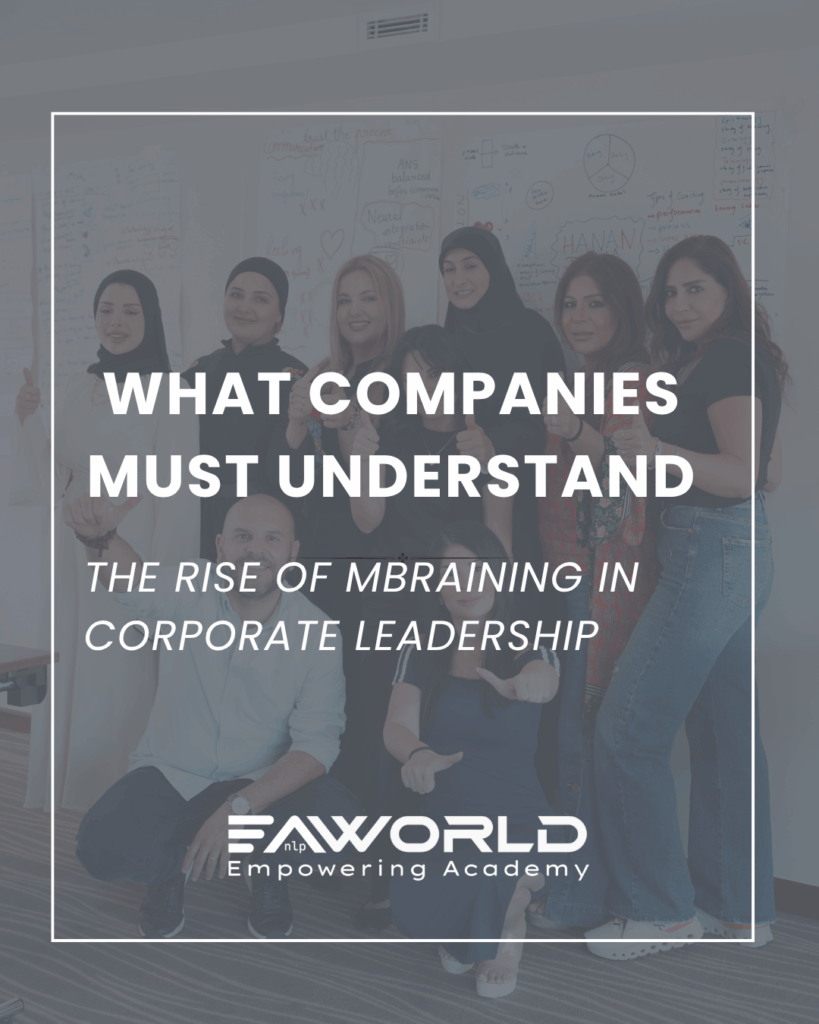
The Rise of mBraining in Corporate Leadership: What Companies Must Understand

mBraining stands for “multiple brain integration techniques,” a methodology that recognizes we have three core intelligences: the head (cognitive), heart (emotional), and gut (instinctual). Neuroscience has confirmed that each of these neural networks has complex processing capabilities. mBraining helps leaders align these intelligences to improve decision-making, communication, and resilience. Why It Matters in Today’s Leadership Landscape Modern executives are navigating complexity that requires more than intellectual IQ. Emotional intelligence (EQ), intuitive decision-making, and value-driven leadership are now crucial capabilities. mBraining provides a framework for integrating all these aspects, helping leaders: Lead with empathy and integrity Make decisions that consider people, values, and long-term impact Navigate stress and emotional triggers with self-awareness Align leadership actions with organizational vision and culture How mBraining Builds Better Leaders Unlike traditional coaching methods that often focus solely on mindset and behavior, mBraining dives deeper into the coherence between thoughts, emotions, and instinct. It allows leaders to: Identify internal conflicts between logic, values, and gut feeling Cultivate alignment across their head, heart, and gut for clearer, more authentic leadership Improve relational intelligence with teams and stakeholders   mBraining in Action: Applications in the Corporate World Companies that incorporate mBraining in executive coaching, team development, and culture-building report measurable benefits, such as: Increased clarity and confidence in decision-making Higher team cohesion and trust Enhanced resilience and stress management A culture of mindful leadership and purpose-driven performance The rise of mBraining marks a paradigm shift in corporate leadership. In a world where cognitive overload, emotional fatigue, and disconnection are prevalent, organizations need leaders who can lead from the inside out. mBraining provides the tools, language, and neuroscience to do just that. For companies ready to move beyond surface-level leadership development, mBraining isn’t just an option — it’s a necessity.

Uncategorized

Using Assessment Tools to Build Emotionally Intelligent Teams

Emotional intelligence (EQ) has become a key determinant of team success. Companies that prioritize EQ in their teams experience higher levels of collaboration, resilience, and productivity. But cultivating emotionally intelligent teams doesn’t happen by chance. It requires intentional strategies—and among the most powerful of these are psychological and behavioral assessment tools. From the Myers-Briggs Type Indicator (MBTI) to EQ-i 2.0, the right tools can move organizations from insight to action. The Importance of Emotional Intelligence in the Workplace Emotional intelligence goes beyond soft skills; it’s a core business competency. Teams with high EQ communicate more effectively, navigate conflict constructively, and respond to pressure with composure. For HR leaders, team managers, and organizational consultants, building emotionally intelligent teams isn’t just a developmental objective—it’s a strategic imperative for long-term success. Companies that embed emotional intelligence into their organizational DNA benefit from improved engagement, lower turnover, and greater employee satisfaction. In environments where adaptability and collaboration are essential, emotionally intelligent teams become an asset that drives innovation and sustained performance. Why Assessment Tools Matter in Developing EQ Assessment tools bridge the gap between subjective interpretation and objective insight. They offer structured, validated frameworks for understanding personality, emotional tendencies, behavioral patterns, and interpersonal strengths. Tools like MBTI, EQ-i 2.0, DISC, and StrengthsFinder help organizations: Identify team dynamics that influence performance and morale Customize coaching and training to individual and team needs Improve communication by highlighting different personality styles Design leadership programs based on real developmental data When assessments are integrated into ongoing talent development strategies, they act as catalysts for emotional intelligence. Teams become more aware of their behaviors, motivations, and blind spots—allowing them to work together with greater empathy and alignment. From Awareness to Application: Turning Results into Action The true power of assessment tools lies in how the insights are applied. This begins with facilitated feedback sessions where team members understand their results in context. Through group workshops, coaching interventions, and cross-functional collaboration exercises, teams start translating awareness into action. For example, if an MBTI workshop reveals a team with predominantly introverted and thinking types, managers can encourage more structured communication forums that allow for thoughtful contribution. If an EQ-i 2.0 assessment reveals low stress tolerance, leadership can prioritize resilience-building practices such as mindfulness training or workload rebalancing. This intentional application transforms assessment tools from one-time diagnostics into sustainable performance drivers. Enhancing Team Culture Through Assessments Emotionally intelligent teams are the foundation of healthy workplace cultures. When individuals are aware of their triggers, communication preferences, and emotional needs, they contribute more openly and constructively to the group. Assessment tools provide a shared language that facilitates deeper understanding and stronger interpersonal connections. For instance, using MBTI across an organization can improve cross-departmental collaboration by helping teams anticipate and respect differences in how colleagues process information or approach deadlines. EQ assessments can inform empathy-building initiatives that reduce workplace conflict and increase cohesion. Leadership’s Role in Facilitating EQ through Assessments Leaders play a pivotal role in modeling and promoting emotional intelligence. By participating in assessments themselves and using the insights to guide their management style, they create a top-down culture of self-awareness and continuous growth. Assessment-based coaching programs can help leaders: Identify how their personality impacts team dynamics Understand the emotional needs of their direct reports Adapt communication and feedback to individual styles The ripple effect is powerful. When leaders embody emotional intelligence, teams are more likely to follow suit. EANLPWorld’s Approach: Strategic Use of Assessment Tools for EQ Development At EANLPWorld, we specialize in converting data into development. Our approach to assessment tools is grounded in applied psychology and coaching excellence. We don’t just administer tests—we design transformation experiences. Whether through MBTI, EQ-i 2.0, or customized team diagnostic tools, our certified consultants guide organizations in leveraging assessments to: Build emotionally intelligent leadership pipelines Facilitate team-building based on real behavioral data Integrate EQ into every aspect of culture and performance By aligning insight with strategy, we help organizations nurture teams that are not just technically competent—but emotionally agile, empathetic, and resilient. Building emotionally intelligent teams is a long-term investment, and assessment tools are the foundation. They offer measurable, meaningful insights that fuel intentional growth. When used correctly, these tools don’t just inform—they transform. They move teams from insight to action, from self-awareness to collective success. As your organization navigates rapid change and increased complexity, let emotional intelligence be your competitive advantage. With the right assessment tools and the right partner—like EANLPWorld—you can build teams that thrive on connection, trust, and performance. Ready to develop emotionally intelligent teams that drive real business results? Discover how our assessment-based solutions can transform your workplace.

Uncategorized

Using MBTI to Improve Workplace Communication, Collaboration, and Culture

Organizational success depends heavily on effective communication, strong team collaboration, and a healthy workplace culture. These human-centered elements require more than guesswork or intuition—they demand clarity and self-awareness. The Myers-Briggs Type Indicator (MBTI) assessment has emerged as a scientifically grounded tool that empowers companies to decode these interpersonal dimensions and create high-functioning environments rooted in understanding and trust. The Science Behind MBTI and Why It Matters The MBTI framework is based on Carl Jung’s psychological type theory and divides personalities into 16 types derived from four dichotomies: Extraversion (E) vs. Introversion (I), Sensing (S) vs. Intuition (N), Thinking (T) vs. Feeling (F), and Judging (J) vs. Perceiving (P). These combinations offer rich insights into how individuals process information, make decisions, manage time, and engage with others. In corporate settings, these insights translate into practical applications. MBTI provides a shared language that helps managers and employees identify communication preferences, build empathy, and resolve conflict. Rather than interpreting behavior through assumptions or bias, leaders are equipped to navigate diversity in working styles with precision. Enhancing Communication Through Personality Awareness One of the primary benefits of MBTI assessments is the improvement of communication strategies across departments. For instance, team members who lean toward Thinking (T) may prefer direct, data-driven dialogue, while those with a Feeling (F) preference value empathetic and people-oriented exchanges. Without this awareness, miscommunication is inevitable. MBTI allows organizations to train teams to adapt their messaging styles based on who they are communicating with—creating an environment where everyone feels heard and understood. HR professionals and managers use MBTI assessments to reduce friction between colleagues, especially during performance reviews, cross-functional projects, or change initiatives. Communication becomes less reactive and more strategic, laying the foundation for organizational cohesion. Building Collaboration Through Complementary Strengths High-performing teams are built on complementary skills and personalities. MBTI assessments offer a blueprint for assembling teams with a balance of visionaries (Intuitive types), executors (Judging types), strategists (Thinking types), and harmonizers (Feeling types). When organizations intentionally compose teams based on these dynamics, collaboration becomes more seamless. Additionally, MBTI creates awareness around stress triggers and coping mechanisms. Knowing how a colleague responds under pressure empowers teammates to offer the right support, reducing conflict and increasing collective resilience. As a result, teams become not just more productive, but more compassionate and psychologically safe. Shaping a Culture of Empathy and Growth Workplace culture is often intangible, but MBTI makes it more measurable. When employees understand and appreciate their own and others’ personality types, they are more likely to engage in respectful dialogue, embrace diversity of thought, and practice inclusive leadership. This leads to a shift from tolerance to genuine collaboration. Organizations that integrate MBTI into their leadership development and coaching programs report stronger alignment between personal values and company vision. Leaders become more self-aware, emotionally intelligent, and better equipped to nurture their teams. A culture grounded in personality insight fosters high retention, strong morale, and a consistent brand identity from the inside out. Why MBTI Is a Strategic Tool for HR and L&D Professionals Talent leaders and HR consultants are increasingly relying on MBTI to guide recruitment, onboarding, conflict resolution, and succession planning. It is particularly effective in: Designing employee engagement programs based on motivational drivers. Reducing attrition by aligning personality with job role and manager style. Facilitating change management through personalized communication. Moreover, MBTI data contributes to a long-term learning and development roadmap. It allows companies to customize training experiences that resonate with different learning preferences and leadership styles, driving better retention and application. How EANLPWorld Leverages MBTI for Organizational Excellence At EANLPWorld, MBTI is more than an assessment; it is a strategic pathway to organizational transformation. Our certified practitioners integrate MBTI evaluations into leadership coaching, team-building workshops, and executive development programs. Each session is customized to the company’s culture, team structure, and strategic objectives. We don’t stop at profiling. We facilitate reflection sessions, deliver interactive feedback debriefs, and map out action plans that align personality insights with real-world goals. Our MBTI-based programs empower teams to: Navigate complex communication scenarios with confidence. Build inclusive and high-functioning teams. Transform culture through empathy and psychological safety. In an increasingly hybrid and cross-cultural work environment, the ability to understand, connect, and lead diverse personalities is a business imperative. MBTI assessments bring clarity to the complexities of human interaction and unlock hidden potential across all levels of an organization. By investing in this tool with the expert support of EANLPWorld, companies can bridge communication gaps, enhance collaboration, and cultivate a culture where people thrive—and where performance follows. Ready to turn personality insights into strategic outcomes? EANLPWorld is your partner in building resilient, emotionally intelligent, and communication-driven workplaces.

Uncategorized

Redefining Organizational Excellence Through Emotional Intelligence

Culture is the invisible force that shapes how people behave, collaborate, and perform within an organization. In high-performing companies, culture is not just a byproduct of success—it is the driver of it. As the workplace becomes increasingly dynamic, the demand for emotionally intelligent organizations is greater than ever. Coaching for emotional intelligence (EQ) offers a transformative pathway to build cultures that are not only high-performing but also deeply human-centered. This article explores how leadership coaching, talent development, and strategic cultural alignment can help businesses build emotionally intelligent workplaces that thrive in complexity and change. The Foundation: Why Emotional Intelligence Matters in Organizational Culture Emotional intelligence—the ability to recognize, understand, and manage one’s own emotions and those of others—is a critical skill for both individual and collective success. While technical competencies can get employees in the door, it’s emotional intelligence that keeps them engaged, collaborative, and innovative. Emotionally intelligent organizations are marked by strong communication, empathy, psychological safety, and trust. As research shows, EQ is more predictive of leadership effectiveness than IQ. When embedded into an organization’s culture through coaching and learning programs, emotional intelligence becomes a strategic asset. It reduces friction, improves decision-making, and fosters resilience during organizational transitions or crisis periods. Coaching as a Catalyst for Cultural Change Executive coaching and organizational coaching are not just development tools; they are cultural interventions. Coaching unlocks awareness, rewires mindsets, and enables intentional behavior change across leadership and team levels. By integrating coaching into the DNA of the company, organizations create space for self-reflection, empathy, and authenticity. Professional coaching interventions enable: Adaptive leadership behavior aligned with company values Clarity of emotional responses and improved interpersonal dynamics Reduced conflict and increased team cohesion A feedback-rich, trust-based environment Coaching for culture involves more than training individuals—it shapes how entire teams communicate, collaborate, and evolve. Building Emotionally Intelligent Organizations: Key Coaching Pillars 1. Leadership Coaching for Emotional Intelligence Leadership is the cornerstone of culture. Coaching senior executives and managers in emotional intelligence skills ensures that emotional agility and authenticity are modeled from the top. Leadership coaching develops: Self-awareness and self-regulation Social awareness and empathy Relationship management and influence As emotionally intelligent leaders emerge, they set a cultural tone that invites openness, encourages learning from failure, and empowers others to lead from their strengths. 2. Coaching for Team Alignment and Trust Emotionally intelligent teams are not only more productive but also more resilient. Coaching interventions at the team level improve mutual understanding, emotional safety, and shared accountability. Using behavioral coaching and systemic team coaching, organizations can: Foster psychological safety and vulnerability-based trust Improve communication in diverse and cross-functional teams Align team values with organizational goals Establish inclusive collaboration practices 3. Culture-Driven Coaching Strategies Coaching should not operate in isolation. When aligned with culture transformation initiatives, it reinforces values and ensures sustainable change. Culture coaching integrates: Values-based assessments and feedback Customized coaching programs by department or business unit Culture audits and strategic alignment workshops Long-term coaching partnerships with HR and L&D functions This integration allows organizations to bridge the gap between stated values and lived experience. Measuring the Impact: KPIs for EQ-Driven Culture Coaching One of the greatest challenges in culture change is measurement. However, coaching for EQ can be evaluated through several meaningful metrics: Increases in employee engagement and psychological safety Decreases in attrition and conflict-related HR cases Improvements in cross-team collaboration scores Higher satisfaction with leadership and communication transparency Many leading organizations now include emotional intelligence as a key competency in performance reviews and succession planning, a trend that reinforces the strategic relevance of EQ coaching. Why Emotionally Intelligent Cultures Are the Future In an era where automation and digital transformation dominate headlines, it is emotional intelligence that defines the human edge. Organizations that coach for culture are not just managing change—they are architecting the future of work. Through professional coaching grounded in EQ, companies can evolve into emotionally intelligent ecosystems where people thrive, collaborate meaningfully, and perform at their highest potential. Whether you are designing a leadership development pipeline or reimagining your culture strategy, coaching for emotional intelligence is not a trend—it’s a business imperative. To create emotionally intelligent organizations, start from the inside out. Build your culture on awareness, empathy, and purpose—and use coaching as the engine of transformation.

Uncategorized

Why mBraining is the Future of Executive Training

The role of executive leaders has evolved far beyond traditional strategic planning and financial decision-making. In today’s volatile, uncertain, complex, and ambiguous (VUCA) business environment, leadership success depends on a deeper integration of emotional intelligence, neuroscience, and adaptability. mBraining—short for “multiple brain integration techniques”—has emerged as a revolutionary model for executive training that develops holistic, values-driven leaders. Its unique combination of neuroscience, behavioral science, and coaching makes it an indispensable tool for forward-thinking organizations. The Science Behind mBraining: Neuroscience Meets Leadership mBraining is grounded in neuroscience research confirming the existence of functional neural networks in the heart and gut, capable of learning, memory, and decision-making. When trained to access and align all three brains, leaders can: Make more congruent and value-aligned decisions Improve communication effectiveness Manage stress and emotional overload more effectively Cultivate intuition for agile leadership As a scientifically validated system, mBraining goes beyond traditional executive coaching by offering a multidimensional framework to tackle leadership complexity from within. Why mBraining is Ideal for Executive Training Programs Traditional executive development programs often emphasize intellectual acumen and strategic problem-solving but neglect the emotional and intuitive dimensions of leadership. mBraining fills this critical gap. Executives trained in mBraining demonstrate: Enhanced empathy and interpersonal skills Increased agility in times of crisis Balanced decision-making that accounts for logic, emotion, and instinct Stronger executive presence and communication impact mBraining is especially effective when integrated into leadership coaching, change management, and organizational development programs. It creates leaders who are not only capable but also conscious and connected. Long-Term Organizational Impact: From Individual Growth to Cultural Transformation Organizations that embed mBraining into their leadership strategy report significant improvements in employee engagement, trust, and collaboration. Leaders who are attuned to their inner intelligence foster cultures that are psychologically safe, innovative, and resilient. Additionally, mBraining contributes to: Reduced executive burnout and decision fatigue Improved cross-functional team alignment Higher levels of trust between leadership and staff Stronger retention of high-potential talent When the leadership core of an organization is emotionally intelligent and value-centered, it cascades through the organizational structure, resulting in more cohesive, purpose-driven workplaces. Integrating mBraining with Coaching and Talent Development mBraining is most impactful when integrated into broader leadership development strategies. Through one-on-one executive coaching, group workshops, and talent assessments, organizations can identify leadership gaps and develop customized pathways using mBraining techniques. Executive training programs that incorporate mBraining often include: Self-awareness modules with biofeedback tools (such as HRV monitoring) Conflict management and decision-making simulations Personalized coaching using multiple brain alignment techniques Follow-up sessions to sustain behavior change and learning This creates a continuous learning loop that reinforces the integration of head, heart, and gut intelligence in everyday leadership practices. Embracing the Future of Leadership with mBraining In an age where complexity, ambiguity, and emotional strain dominate the executive landscape, mBraining is no longer a luxury but a necessity. It provides a powerful system for accessing deeper self-awareness, building ethical leadership, and cultivating resilience. Forward-looking companies that prioritize the internal growth of their leaders through integrative approaches like mBraining are better positioned to navigate disruption, inspire trust, and create sustainable impact. If your organization is ready to future-proof its leadership development strategy, mBraining offers the roadmap to align cognitive brilliance with emotional depth and intuitive insight. The result? Leaders who don’t just manage complexity—they transform it into opportunity.

Uncategorized

Customized Coaching Programs That Drive Measurable Organizational Growth

In a landscape where market dynamics evolve at lightning speed, companies must prioritize talent development and leadership agility. Traditional one-size-fits-all training models often fall short in meeting the nuanced challenges of modern organizations. This is where customized coaching programs step in as transformative tools, aligning individual development with strategic business outcomes to drive measurable organizational growth. Why Customization Matters More Than Ever Every organization is unique—defined by its industry, culture, growth stage, and leadership challenges. Standardized coaching approaches overlook these contextual factors, often leading to low engagement and minimal impact. In contrast, customized coaching programs: Address specific organizational pain points Align with corporate goals and KPIs Support individual growth within team and department structures Build on company values and cultural norms Tailoring coaching content, delivery format, and learning pathways ensures the training resonates at every level—from emerging leaders to senior executives. Core Elements of High-Impact Customized Coaching 1. Needs Assessment and Strategic Alignment The process begins with a diagnostic phase where organizational goals, leadership gaps, and cultural dimensions are analyzed. This includes: Executive interviews 360-degree feedback Talent audits KPI reviews The insights gained are used to shape coaching programs that directly support growth, innovation, retention, and performance. 2. Personalized Development Plans Each participant receives a roadmap tailored to their strengths, gaps, and goals. Coaching topics may include: Executive presence and communication Emotional intelligence (EQ) development Strategic decision-making Change management and agility Cross-functional leadership 3. Modular & Adaptive Learning Design The most effective coaching programs are delivered in modular formats, allowing flexibility. Sessions can be one-on-one, in small groups, or hybrid. This adaptive approach supports: Real-time leadership challenges Continuous feedback loops Just-in-time learning applications 4. Behavioral Reinforcement and Accountability Coaching without measurement is a missed opportunity. The best programs include: KPIs linked to business performance Self-assessment tools Regular progress reviews Peer feedback These mechanisms ensure that coaching translates into real behavior change and ROI. Measurable Business Impact of Customized Coaching Companies that implement tailored coaching programs report: Increased leadership effectiveness Higher employee engagement and retention Faster change adoption Improved cross-functional collaboration Accelerated succession planning For example, one global tech firm saw a 25% improvement in team productivity and a 40% rise in employee engagement scores within six months of launching a customized coaching initiative for middle managers. The Role of EANLPWorld in Delivering Customized Coaching Excellence EANLPWorld specializes in designing and delivering cutting-edge, customized coaching programs for organizations across industries. Our approach combines: Internationally certified coaches Neuro-Linguistic Programming (NLP) Emotional intelligence and mBraining methodologies Deep understanding of organizational psychology Whether you’re developing future leaders, navigating transformation, or fostering a culture of continuous learning, EANLPWorld partners with you to create high-impact coaching experiences that are measurable, scalable, and aligned with your strategic goals. Our coaching solutions include: Executive and leadership coaching High-potential talent development Team alignment and performance coaching Culture and change management facilitation In an era where adaptability, emotional intelligence, and innovation define business success, customized coaching is no longer optional—it’s a strategic imperative. Organizations that invest in tailored development programs not only future-proof their leadership pipeline but also build resilient, high-performing cultures. With EANLPWorld as your coaching partner, you gain access to personalized development solutions that translate insight into action, and potential into performance. Let us help you build a leadership culture that drives sustainable, measurable growth.

Uncategorized

Organizational Intelligence Starts Within: How mBraining Drives Team Cohesion

In an era where organizational success is defined by the quality of collaboration and the ability to adapt quickly, leaders must harness a deeper level of understanding within their teams. Organizational intelligence goes beyond data analytics and process optimization; it is rooted in aligning the cognitive, emotional, and instinctive capacities of team members. This is where mBraining—a unique approach that integrates the head, heart, and gut—plays a pivotal role. mBraining allows leaders and teams to tap into their holistic intelligence, aligning thoughts, feelings, and instincts to foster trust, collaboration, and long-lasting team cohesion. What is mBraining and Its Impact on Team Dynamics? mBraining is a multi-disciplinary approach combining neuroscience, behavioral psychology, and emotional intelligence. At its core, it operates on the premise that human intelligence operates across three centers of knowing: the head (cognitive), the heart (emotional), and the gut (instinctive). By teaching team members to recognize and utilize these three centers, organizations can create a culture where trust, clarity, and cooperation flourish. In practice, this means more effective communication, heightened emotional resilience, and an intuitive sense for aligning individual talents within the team. Why mBraining Is Critical for Building High-Performing Teams Modern teams operate in a complex environment where rapid change and high-stakes decisions are the norm. The mBraining approach empowers team members to connect deeply with themselves and others, making it an ideal solution for addressing the nuanced challenges faced by businesses in competitive markets. Through enhanced self-awareness and emotional mastery, team members learn to recognize their triggers, manage their responses, and engage in constructive, productive dialogue. This results in higher levels of trust and stronger team alignment, making mBraining a cornerstone for building resilient and successful teams. Driving Team Cohesion Through Integrated Intelligence By aligning the head, heart, and gut intelligences of team members, mBraining creates a pathway to deeper collaboration and trust within the organization. When team members operate from a state of internal coherence, their external interactions become more aligned, productive, and empathic. This creates a team dynamic that is adaptable, collaborative, and capable of achieving ambitious goals despite external pressures and internal constraints. The Role of mBraining in Leadership Development For leaders and managers, mBraining provides a critical lens for understanding the multi-dimensional nature of their role. In environments that demand precision, resilience, and emotional acuity, leaders can utilize mBraining techniques to balance their rational thinking with emotional and instinctual wisdom. This allows for more inclusive decision-making, improved team alignment, and a profound sense of trust across all levels of the organization. An executive who embraces mBraining is positioned to foster a culture of belonging and purpose, making it an ideal approach for organizations pursuing long-term success. mBraining as a Framework for Sustainable Organizational Growth The application of mBraining goes beyond the team level, providing a systemic approach for aligning organizational culture with strategic objectives. By nurturing the interplay between head, heart, and gut intelligences, mBraining allows businesses to cultivate an environment where innovation, collaboration, and resilience can thrive. This approach is especially valuable for organizations seeking to navigate transformation, mergers, and acquisitions, or scale globally, as it ensures that teams operate from a shared state of coherence and alignment. Making mBraining a Strategic Advantage for Your Organization Modern organizations must evolve beyond traditional metrics of productivity and efficiency. True organizational intelligence emerges when teams operate from an integrated state of internal alignment, leveraging their cognitive, emotional, and instinctive wisdom. By incorporating mBraining into leadership and team development, businesses can foster a culture that embraces trust, collaboration, and resilience—key drivers for long-term growth and competitive advantage. At EANLPWorld, we specialize in mBraining coaching that empowers leaders and teams to tap into their collective intelligence, creating organizations that are as adaptable and connected as they are successful.

Uncategorized

The ROI of EQ Training: Building Resilient Leaders in Uncertain Times

Emotional intelligence (EQ) has emerged as a critical differentiator for leaders. The ability to understand, manage, and effectively utilize emotions is no longer a “soft” skill but a vital competency that directly impacts organizational resilience and performance. Investing in EQ training delivers a significant return on investment (ROI), making it a cornerstone of forward-thinking leadership and workforce development. The Impact of Emotional Intelligence on Leadership Effectiveness Leaders with high emotional intelligence can build trust, navigate conflict, and foster collaboration across teams. By aligning emotional awareness with strategic objectives, these leaders drive employee engagement and create environments where people can thrive despite external pressures. The benefits of EQ training are evident in metrics such as employee retention, productivity, and overall team performance. Building Organizational Resilience Through EQ Training Resilient organizations are built upon resilient leaders. EQ training provides leaders with the tools to navigate complex emotional landscapes, respond adeptly to crisis situations, and maintain focus under pressure. The results are profound: improved problem-solving abilities, reduced employee burnout, and stronger team cohesion. These outcomes create a competitive advantage that is especially vital in times of disruption and uncertainty. The Cost-Benefit Equation: Why EQ Training is a Smart Investment While traditional metrics focus on hard returns, the benefits of EQ training often yield long-term, transformational results. Investing in emotional intelligence development reduces turnover, improves performance metrics, and strengthens an organization’s culture. In fact, research by leading institutions suggests that every dollar invested in EQ training can yield a significant multiplier effect, making it one of the highest-ROI investments available for talent and leadership development. Integrating EQ Training into Leadership Development Programs Modern organizations recognize the necessity of making emotional intelligence a core component of their leadership training and talent pipelines. Through executive coaching, group workshops, and digital learning platforms, businesses can embed EQ competencies into the DNA of their culture. The result is a cadre of leaders adept at making nuanced decisions, leading diverse teams, and nurturing a collaborative environment built for long-term success. EQ Training as a Competitive Advantage As the business landscape grows increasingly complex, leaders with high emotional intelligence stand out as a pivotal force for resilience and growth. By prioritizing EQ training, organizations not only foster stronger, more adaptable leaders but also build a culture that can weather disruption and thrive amid uncertainty. In times when resilience and emotional acuity matter more than ever, EQ training is a strategic investment that delivers exponential returns—for both leaders and their organizations.

Uncategorized

The Psychology Behind Performance: Coaching for Critical Leadership Skills

Performance is no longer measured solely by numbers and outcomes. Today, performance is deeply rooted in the psychological makeup of leaders and their ability to influence, motivate, and drive results through others. The integration of coaching with psychological principles has become essential to unlocking this potential, giving rise to performance coaching as a powerful tool for developing critical leadership skills. Understanding the Psychology of Leadership Performance Leadership is a psychological process as much as it is an operational function. It requires self-awareness, emotional intelligence, resilience, adaptability, and the cognitive ability to navigate uncertainty. Modern leaders are expected to lead diverse teams, manage complex projects, and communicate effectively across cultural and generational lines. To meet these demands, they must understand their own thought patterns, emotional responses, and behavioral tendencies. Coaching programs grounded in psychology offer the insight and support necessary to enhance these internal drivers of performance. Through structured dialogue, behavioral analysis, and reflective practices, coaching enables leaders to build awareness of how their mindset and behaviors impact team performance, decision-making, and organizational outcomes. Why Coaching is Essential for Leadership Success? Leadership coaching empowers individuals to unlock their full potential by addressing personal and professional development areas. Coaches act as strategic thought partners, helping leaders navigate challenges and seize opportunities. With techniques derived from behavioral science, neuroscience, and organizational psychology, coaching is no longer seen as a remedial measure but as a strategic investment in leadership capacity building. Organizations that integrate coaching into their leadership development frameworks see measurable benefits, such as increased employee engagement, stronger decision-making, improved communication, and reduced executive burnout. These outcomes contribute directly to organizational growth and long-term sustainability. Developing Critical Leadership Skills Through Coaching Performance coaching focuses on enhancing the core competencies that define effective leadership. These include: Emotional Intelligence (EQ): Leaders with high EQ are better equipped to handle interpersonal dynamics, foster collaboration, and manage stress. Coaching enhances EQ by improving self-awareness, empathy, and emotional regulation. Decision-Making Under Pressure: Coaches help leaders understand their cognitive biases, evaluate risk objectively, and make high-stakes decisions with clarity and confidence. Strategic Thinking and Vision: Through guided questioning and mental modeling, coaching encourages leaders to think long-term, align actions with vision, and communicate strategy effectively. Communication and Influence: Coaching sharpens verbal and non-verbal communication skills, enabling leaders to inspire trust and mobilize teams. Resilience and Stress Management: Drawing from performance psychology, coaching equips leaders with techniques to stay grounded and productive in high-pressure situations. The Role of Tailored Coaching Programs in Organizational Growth Generic leadership training often fails to meet the unique challenges faced by executives and senior managers. Customized coaching programs address this gap by aligning interventions with organizational goals and the individual leader’s development needs. When coaching is tailored to the organization’s strategic direction, it creates alignment between leadership behavior and desired business outcomes. This fosters a culture of accountability, innovation, and continuous improvement. Executives who engage in personalized coaching demonstrate stronger leadership presence, make more informed decisions, and are better prepared to lead through change. Long-tail keywords such as “executive leadership coaching programs,” “emotional intelligence coaching for leaders,” “resilience training for executives,” and “performance coaching for senior managers” ensure content visibility to decision-makers seeking targeted solutions for leadership development. Integrating Psychology-Based Coaching with Business Strategy At EANLPWorld, we specialize in delivering customized coaching experiences that go beyond surface-level training. Our programs are rooted in advanced psychological frameworks, including Neuro-Linguistic Programming (NLP), emotional intelligence, and mBraining methodologies. Our internationally certified coaches bring a unique blend of business acumen and psychological expertise, ensuring that each engagement drives measurable outcomes. Whether you’re cultivating a high-potential talent pipeline or equipping your C-suite for transformation, our coaching programs align personal growth with organizational performance. The demands on modern leaders are more complex than ever. Coaching, when grounded in psychology, becomes the catalyst for developing leaders who are emotionally intelligent, strategically focused, and resilient in the face of change. As the business world continues to shift, investing in performance coaching is not just a trend—it is a necessity for sustainable success. By integrating psychological insight with leadership development, organizations can build a future-ready leadership bench capable of navigating complexity, driving innovation, and inspiring teams. Unlock leadership excellence through psychology-based coaching. Discover how EANLPWorld can partner with your organization to build high-impact leaders who deliver results.

Uncategorized

The Strategic Role of MBTI Assessment in Modern Organizations

businesses evolve to meet complex demands, understanding the personality dynamics of employees becomes a competitive advantage. This is where the Myers-Briggs Type Indicator (MBTI) emerges as a strategic tool. More than just a personality test, MBTI provides actionable insights that can enhance team performance, leadership effectiveness, and employee satisfaction. What Is the MBTI Assessment? The MBTI is a psychometric tool developed to help individuals understand their personality preferences based on four dimensions: Extraversion vs. Introversion, Sensing vs. Intuition, Thinking vs. Feeling, and Judging vs. Perceiving. This framework results in 16 unique personality types, offering a structured way to explore how people perceive the world, make decisions, and interact with others. Unlike generic personality quizzes, MBTI is rooted in psychological theory and widely adopted in global corporate settings. It’s trusted by Fortune 500 companies, leadership development firms, and HR consultants for its reliability and practical application in business environments. Why Are Personality Assessment Tools Important in the Workplace? Personality assessments like the MBTI are not just tools for self-awareness—they are strategic enablers of organizational growth. Here’s why they matter: Enhanced Self-Awareness: Employees who understand their communication style, decision-making process, and work preferences are more confident and effective. Improved Team Dynamics: MBTI helps managers build balanced teams by pairing complementary personalities, fostering trust and collaboration. Targeted Leadership Development: By identifying leadership styles, MBTI enables tailored coaching and succession planning. Reduced Conflict: Understanding different personalities minimizes misunderstandings and encourages empathy, leading to healthier workplace relationships. Increased Engagement and Retention: Employees who feel understood and supported are more engaged and likely to stay with the organization. Using MBTI Assessment Tools in Corporate Settings 1. Team Building and Conflict Resolution MBTI can be a powerful tool for improving interpersonal communication and reducing friction in teams. HR professionals can facilitate workshops where teams review their MBTI profiles, understand their strengths, and explore potential friction points. This awareness allows teams to proactively manage conflict and improve collaboration. 2. Leadership Development Programs In executive coaching or leadership development tracks, MBTI offers insight into how a leader naturally thinks, feels, and behaves under pressure. This self-knowledge can drive growth, help them adapt their style for diverse teams, and strengthen their decision-making capabilities. 3. Talent Management and Succession Planning Organizations use MBTI as part of their talent assessment strategy to map employee strengths, identify high-potential individuals, and design development plans aligned with business needs. This data-driven approach leads to smarter promotions and greater role alignment. 4. Onboarding and Employee Integration New hires who take an MBTI assessment during onboarding gain immediate insight into how they fit within the company culture. Managers can use these insights to assign mentors, customize communication, and shorten the ramp-up period. Long-Term Strategic Benefits of MBTI Integration When implemented systematically, MBTI assessments contribute to the creation of a learning organization—one where feedback, communication, and personal development are central to the culture. Organizations report long-term benefits including: Stronger organizational cohesion Adaptive leadership pipelines Improved employee well-being and job satisfaction Better alignment between individual and team goals How EANLPWorld Integrates MBTI into Organizational Development At EANLPWorld, we go beyond administering MBTI assessments. We translate assessment insights into action. Our certified consultants work closely with HR leaders, department heads, and executive teams to: Conduct comprehensive MBTI evaluations Design team-building experiences based on personality profiles Integrate MBTI with coaching, leadership training, and communication workshops Provide follow-up sessions that reinforce and expand on initial learnings Our MBTI-based interventions are part of a larger strategy to build emotionally intelligent, performance-driven, and resilient organizations. The MBTI assessment is not a silver bullet, but when used with intention and expert facilitation, it becomes a vital asset in any organization’s HR strategy. From fostering high-performing teams to cultivating emotionally intelligent leaders, MBTI serves as a catalyst for transformation. In a business world defined by complexity, the greatest advantage is knowing your people. With the MBTI tool and expert guidance from EANLPWorld, your organization can uncover hidden potential, resolve internal barriers, and build a workplace that thrives on both individuality and unity. Ready to integrate MBTI into your organizational development journey? Let EANLPWorld help you shape a more dynamic, empathetic, and results-driven workplace.

Uncategorized

Well-Being Meets Performance: The New Era of Leadership Coaching in the Workplace

The intersection of well-being and performance has emerged as the defining paradigm of 21st-century leadership. As organizations confront unprecedented volatility, high executive turnover, and burnout epidemics, the role of leadership coaching has expanded from performance enhancement to holistic leader development. Today, successful companies recognize that sustainable business performance is directly tied to the mental, emotional, and relational well-being of their leaders. This is the new era of leadership coaching, where well-being meets performance. The Shift in Leadership Demands Traditional leadership models emphasized productivity, goal achievement, and authority. But the modern workplace demands much more. Leaders are now expected to: Foster psychological safety Cultivate empathy and emotional intelligence Navigate hybrid workforces and cross-cultural teams Model resilience under pressure Drive inclusion, innovation, and agility simultaneously These evolving expectations make leadership more human—and more complex. Coaching must evolve accordingly. What Is Well-Being-Centric Leadership Coaching? Well-being-centric leadership coaching integrates mental wellness, emotional intelligence, and personal development into traditional coaching frameworks. It goes beyond executive performance metrics to focus on: Mindset transformation Stress resilience and energy management Emotional regulation and authenticity Work-life integration Inner clarity and values alignment By addressing the inner world of the leader, this coaching style builds the capacity to lead others effectively and sustainably. Key Benefits of Well-Being-Focused Coaching Improved Decision-Making When leaders operate from a state of calm and clarity, they make better decisions. Coaching that enhances emotional regulation reduces impulsive reactions and improves strategic thinking. Lower Burnout and Turnover Organizations with well-supported leaders report significantly lower burnout rates and higher retention. Leaders who prioritize their own well-being model healthier behaviors for their teams. Elevated Emotional Intelligence Leadership coaching develops the self-awareness and empathy required to manage complex interpersonal dynamics—key to high-performing teams. Enhanced Executive Presence Well-being coaching boosts authenticity, groundedness, and clarity—traits that contribute to a powerful and inspirational leadership presence. Cultural Transformation When leaders shift, culture shifts. Leaders who embrace holistic coaching often become catalysts for psychological safety, innovation, and engagement across their organizations. Tools and Methodologies That Bridge Well-Being and Performance Well-being leadership coaching employs tools from multiple disciplines: NLP (Neuro-Linguistic Programming): Reframes limiting beliefs, strengthens communication, and aligns inner states with external outcomes. mBraining: Connects the intelligence of head, heart, and gut for aligned decision-making and authentic leadership. Mindfulness and Somatic Practices: Cultivates presence, stress awareness, and nervous system regulation. EQ Assessments and Development Plans: Provides metrics and strategies for emotional intelligence growth. Strength-Based and Values-Based Coaching: Ensures alignment between inner drivers and organizational goals. EANLPWorld: Pioneering Well-Being-Driven Executive Coaching EANLPWorld stands at the forefront of this coaching revolution. With a multi-disciplinary team of certified coaches, trainers, and organizational psychologists, we offer bespoke leadership coaching that integrates well-being with strategic leadership development. Our coaching programs support: Senior executives navigating transformation Middle managers building resilience and capacity Teams developing collective emotional intelligence Organizations shifting from reactive to regenerative cultures Whether you’re seeking 1:1 executive coaching, team interventions, or company-wide leadership programs, EANLPWorld delivers evidence-based, human-centric solutions. As we enter a new chapter of organizational growth, the most successful leaders will be those who lead from wholeness—not just from the head, but also from the heart and gut. Integrating well-being into leadership isn’t a luxury—it’s a performance imperative. The future of leadership is compassionate, grounded, and resilient. Let EANLPWorld guide your leadership journey into this new era—where performance meets purpose, and well-being drives sustainable success.

Uncategorized

Executive Emotional Intelligence: The Leadership Superpower of 2025

Emotional Intelligence (EI) — the nuanced, powerful ability to understand, manage, and influence emotions in oneself and others. As business complexity increases and human-centric leadership becomes a competitive necessity, Executive Emotional Intelligence has emerged as the true superpower that fuels resilience, trust, innovation, and loyalty within organizations. Understanding Executive Emotional Intelligence in 2025 Executive Emotional Intelligence goes beyond basic interpersonal skills. It embodies a sophisticated blend of self-awareness, self-regulation, empathy, social skill, and internal motivation. These five pillars, as defined by Daniel Goleman, have evolved to meet the modern demands of high-stakes leadership, where pressure, diversity, rapid change, and distributed teams are the norm. In 2025, EI is no longer a ‘soft skill’ — it is a core strategic competency. Executives who possess high EI navigate complexity with clarity, build cultures of psychological safety, and inspire through authenticity. Why Emotional Intelligence Is a Leadership Imperative 1. Navigating Uncertainty and Complexity The post-pandemic world and AI-driven transformations have made ambiguity a permanent fixture. Emotionally intelligent leaders remain grounded amid uncertainty, using emotional data as a compass for strategic decision-making. 2. Enhancing Team Engagement and Retention High EI enables executives to forge deeper connections with their teams. Leaders who actively listen, validate feelings, and foster inclusive dialogue are more likely to retain top talent and sustain engagement in hybrid or remote settings. 3. Influencing with Integrity Influence without manipulation is the mark of a modern leader. EI empowers executives to communicate with impact, handle resistance gracefully, and lead ethically by aligning actions with values. 4. Driving Innovation Through Psychological Safety Innovation thrives where people feel safe to speak up. Emotionally intelligent leaders create environments where feedback is welcomed, failure is reframed, and diverse voices are heard. The Neuroscience Behind EI: A 2025 Perspective Advances in neuroscience have deepened our understanding of EI, revealing how emotional regulation, empathy, and decision-making are rooted in brain function. The interplay between the prefrontal cortex (reasoning), limbic system (emotion), and autonomic nervous system (stress response) determines how we show up as leaders. In 2025, leading organizations are using neuro-informed assessments and biofeedback to measure and cultivate EI competencies in their executives. Integrating EI into Executive Development Forward-thinking companies embed Emotional Intelligence into their leadership pipelines through: Executive coaching with an EI focus Mindfulness-based emotional regulation training Resilience and stress management programs 360° feedback and behavioral assessments Leadership retreats and immersive simulations The ROI? Enhanced leadership effectiveness, reduced burnout, stronger cross-functional collaboration, and measurable improvements in organizational climate. The Future of EI: Trends Shaping 2025 and Beyond AI-EI Integration: Digital tools that assess and coach for EI using behavioral data   EI in Executive Hiring: Emotional competency profiling as a core metric   Global EI Standards: Movement toward international certification for emotional competencies Hybrid EQ Leadership Models: Balancing digital empathy with human presence in remote environments Unlocking Your Executive Superpower with EANLPWorld At EANLPWorld, we understand that great leadership is as much about the heart as the mind. Our advanced coaching and training programs are designed to elevate Emotional Intelligence at the executive level, combining cutting-edge neuroscience, NLP methodologies, and experiential learning. Whether you’re navigating change, leading diverse teams, or preparing for the next phase of growth, enhancing your EI is not a luxury — it’s a leadership necessity. With personalized coaching, team immersion labs, and long-term strategic development, we help executives harness their emotional intelligence as their most valuable asset. The Competitive Edge in a Human-Centered Future In 2025, organizations don’t just need leaders who are intelligent or experienced — they need leaders who are emotionally attuned, mentally agile, and humanly impactful. Executive Emotional Intelligence is not only a differentiator; it is the defining superpower of future-ready leadership. Empower your leadership evolution. Start with EANLPWorld, where Emotional Intelligence meets executive excellence.

Uncategorized

Using NLP to Transform Team Dynamics and Executive Presence

As organizations become increasingly complex and global, executive leaders face growing challenges in managing teams, fostering innovation, and inspiring performance. One powerful, science-based approach that’s gaining momentum in leadership development and corporate coaching is Neuro-Linguistic Programming (NLP). Used strategically, NLP can dramatically enhance team dynamics and elevate executive presence. Transforming Team Dynamics Through NLP 1. Building Deep Rapport for Collaborative Cultures At the heart of high-performing teams is trust. NLP teaches leaders how to build rapport quickly through mirroring techniques, body language awareness, and sensory acuity. These skills enable executives to create inclusive environments where team members feel heard, valued, and motivated to contribute. 2. Enhancing Communication Clarity Miscommunication is a common root of team conflict. NLP emphasizes the importance of clear, intentional language. Leaders trained in NLP learn how to: Avoid ambiguity and assumptions Use language patterns that inspire action Tailor messages to different personality types This leads to fewer misunderstandings, more efficient collaboration, and greater alignment across departments. 3. Managing Conflict and Emotional Reactions Conflicts are inevitable in any workplace. What matters is how they are handled. NLP equips executives with tools to manage emotional states, shift perspectives, and defuse tension. Techniques like perceptual positioning allow leaders to understand issues from multiple viewpoints, promoting empathy and resolution. 4. Anchoring Positive States for Team Performance NLP uses anchoring to link positive emotions (like confidence, motivation, or calm) to specific triggers. Executives can use this technique to help teams anchor resourceful states before important meetings or high-stakes projects, elevating collective performance. Enhancing Executive Presence Through NLP 1. Commanding the Room with Nonverbal Intelligence Executive presence isn’t just about what you say—it’s about how you show up. NLP heightens awareness of nonverbal cues, such as posture, tone, pace, and facial expressions. Leaders who master these elements project confidence, credibility, and approachability. 2. Framing Messages for Influence and Impact Through the use of advanced language patterns like metaphor, storytelling, and future pacing, NLP-trained leaders can frame messages in ways that resonate deeply with audiences. This enhances persuasion without manipulation, creating buy-in and motivation. 3. Developing Emotional Intelligence and Self-Mastery NLP integrates techniques for emotional regulation, self-awareness, and mindset shifts. Executives with high emotional intelligence are better equipped to lead during uncertainty, foster resilience, and set a powerful example for their teams. 4. Shaping Identity and Vision Executive presence is deeply tied to identity. NLP helps leaders align their internal beliefs with their external behaviors, cultivating authenticity. Visualization and belief change techniques empower leaders to embody their roles more fully, inspiring others through aligned leadership. NLP in Action: Corporate Training and Coaching Organizations that invest in NLP-based executive coaching and team training report measurable improvements in communication, productivity, and morale. Corporate NLP programs can include: Leadership development workshops Team-building retreats Executive coaching sessions Conflict resolution facilitation Communication skills masterclasses These programs can be customized based on industry, company culture, and leadership challenges, making NLP a highly adaptable and strategic asset. Why EANLPWorld is Your Trusted Partner in NLP-Based Leadership Solutions At EANLPWorld, we specialize in bringing cutting-edge NLP strategies to the corporate world. Our programs are designed for high-level executives, senior managers, and teams looking to elevate their performance and leadership capacity. With certified NLP experts and a track record of impact across industries, we empower organizations to harness the full potential of Neuro-Linguistic Programming. Whether you’re looking to transform communication within your team, enhance your executive presence, or embed emotional intelligence into your leadership culture, EANLPWorld provides the expertise, tools, and customized training to get you there. In 2025 and beyond, the leaders who will stand out are those who understand the power of mindset, communication, and emotional mastery. NLP offers a practical, neuroscience-backed framework for transforming how leaders think, act, and connect with others. By integrating NLP into your executive strategy, you can reshape your organization’s culture, elevate team dynamics, and project a leadership presence that drives sustained success. Let NLP be the catalyst that transforms your leadership journey. Start with EANLPWorld.

Uncategorized

Integrating mBraining into Corporate Training: A Strategy for Organizational Growth

mBraining into corporate training serves as a powerful driver for sustainable organizational growth, employee development, and leadership transformation. As corporate training evolves to meet 21st-century demands, a groundbreaking methodology has emerged at the intersection of neuroscience and leadership development: mBraining (multiple Brain Integration Techniques). This scientifically grounded approach to decision-making, communication, and alignment is revolutionizing how companies design and deliver leadership training, emotional intelligence programs, and performance enhancement strategies. Understanding mBraining: The Science Behind Multiple Brain Integration mBraining is based on cutting-edge neuroscience that confirms the existence of complex, functional neural networks in the head (cognitive brain), heart (emotional brain), and gut (instinctual brain). Each of these centers processes information, stores memories, and influences behavior in unique and interdependent ways. Unlike traditional training models that prioritize cognitive development alone, mBraining aligns and activates all three intelligences, enabling leaders and teams to make wiser decisions, regulate emotions, and act in ways that are coherent with their personal values and organizational goals. Why mBraining Belongs in Corporate Training Programs Corporate training initiatives often struggle to create long-lasting behavioral change. mBraining addresses this by embedding transformation at a neurological level—resulting in deeper learning, emotional regulation, and purpose-aligned action. Enhanced Leadership Decision-Making Training that incorporates mBraining helps executives and managers use head-based logic, heart-based compassion, and gut-based courage in harmony. This leads to more ethical, courageous, and people-centered leadership. Emotional Intelligence Development mBraining boosts self-awareness, empathy, and relationship management, critical components of emotional intelligence (EQ)—now considered a top predictor of leadership success. Agility and Resilience In a business landscape characterized by constant disruption, organizations need leaders who respond—not react—to change. mBraining helps develop the internal coherence necessary for calm, grounded, and confident leadership in times of stress. Greater Team Collaboration By cultivating emotional coherence and trust, mBraining fosters psychological safety, a key driver of team performance and innovation. Long-Term Organizational Benefits of mBraining Integration Organizations that embed mBraining into their learning architecture experience transformative, enterprise-wide outcomes: Increased employee retention and engagement Stronger leadership pipelines Improved conflict resolution and communication skills Elevated corporate culture aligned with core values More authentic, purpose-driven performance metrics Reduced burnout and emotional fatigue in high-stress roles mBraining vs. Traditional Training: A Strategic Upgrade Traditional corporate training often emphasizes knowledge transfer and behavioral change without addressing the neurological alignment needed for sustainable transformation. mBraining shifts this paradigm. Training Dimension Traditional Training mBraining-Integrated Training Focus Head (cognitive skills only) Head, Heart, Gut (whole-system alignment) Learning Depth Surface-level knowledge Deep neurological and behavioral rewiring Emotional Intelligence Limited to theoretical models Embodied and experiential development Adaptability & Decision Making Linear thinking Intuitive, compassionate, value-aligned Sustainability of Change Inconsistent retention Long-lasting internalized transformation Use Cases: mBraining in Corporate Development Initiatives 🔹 Executive Coaching & Leadership Development Senior leaders undergo mBraining-based coaching to improve influence, presence, and conscious decision-making in high-stakes environments. 🔹 Talent Development Programs Emerging leaders learn how to align their actions with organizational purpose while staying emotionally grounded and visionary. 🔹 Change Management Training Change agents are trained to regulate emotional resistance, instill clarity, and build trust during times of transition. 🔹 Sales & Customer Experience Sales teams apply mBraining techniques to enhance empathy, rapport, and integrity in client interactions—improving close rates and long-term client relationships. Measurable ROI: The Impact of mBraining on Organizational KPIs Forward-looking organizations using mBraining in corporate training report: 35% increase in emotional intelligence scores   30% improvement in leadership effectiveness ratings   28% reduction in stress-related absenteeism   25% growth in innovation and idea generation   40% higher employee engagement metrics   These outcomes directly influence profitability, agility, and enterprise sustainability. As the workforce becomes more emotionally aware, complex, and distributed, businesses must evolve beyond conventional training to foster whole-brain leadership. mBraining offers an advanced, scientifically proven methodology for cultivating emotional intelligence, intuitive decision-making, and collaborative culture. If you’re looking to future-proof your organization, integrating mBraining into your corporate training strategy isn’t just a smart choice—it’s a competitive advantage. Partner with EANLPWorld to bring mBraining into your business and shape a future of resilient, emotionally intelligent leaders.

Uncategorized

From Head to Heart to Gut: A Comprehensive Guide to mBraining for Executives

mBraining, or multiple Brain Integration Techniques (mBIT), is based on recent discoveries in neuroscience that confirm humans have complex, functional neural networks in three key areas: Head brain – responsible for cognition, analysis, and reasoning Heart brain – governing emotional processing, compassion, and relational values Gut brain – influencing instinct, courage, and action-taking These three “brains” communicate bidirectionally with one another and can function in alignment—or in conflict—depending on internal coherence. mBraining provides structured processes to align these intelligences, enabling executives to make wiser, emotionally balanced, and value-aligned decisions. Why mBraining Matters for Executives and Business Leaders The Head Brain: Beyond Analysis and Logic While analytical thinking remains essential, the head brain alone is no longer sufficient in today’s leadership landscape. Over-reliance on logic can lead to paralysis by analysis, indecision, or emotionally tone-deaf leadership. mBraining enables leaders to optimize head brain functions in harmony with heart and gut intelligence, creating a more integrated and strategic mindset. The Heart Brain: Emotional Intelligence and Values-Based Leadership Emotionally intelligent leadership is now a key differentiator in effective executive performance. The heart brain governs compassion, empathy, and emotional awareness, all of which contribute to high-trust leadership and employee engagement. With mBraining, executives can access emotional clarity and align decisions with deeply held values—transforming transactional leadership into purpose-driven influence. The Gut Brain: Courage, Risk, and Intuitive Action The gut brain governs our core sense of identity, courage, and instinctive behavior. In high-pressure environments, gut intelligence plays a critical role in risk assessment, resilience, and executive presence. mBraining activates this center for confident, instinctual decision-making—crucial in moments requiring bold leadership. Benefits of mBraining for Executive Leadership Integrating mBraining into executive coaching and leadership development leads to measurable benefits: Improved decision-making under pressure Enhanced emotional intelligence and empathy Greater resilience and mental clarity Higher team engagement and trust Faster conflict resolution and communication agility Authentic, values-driven leadership behavior How mBraining Enhances Strategic Leadership Capabilities 🔹 Decision-Making Clarity When head, heart, and gut are in alignment, executives experience decisive clarity, even in uncertain conditions. This reduces internal conflict and boosts execution speed. 🔹 Emotionally Intelligent Leadership mBraining strengthens the emotional bandwidth of leaders, enabling them to handle interpersonal dynamics, emotional contagion, and leadership under stress. 🔹 Visionary Thinking & Innovation Accessing multi-intelligence integration helps leaders tap into creative insight and forward-thinking strategies, essential for navigating disruption and innovation. 🔹 Resilient Communication Style By leveraging the gut for courage and the heart for empathy, executives develop a balanced communication style that earns respect and trust at every level. Real-World Application of mBraining in the C-Suite Executive Coaching & Transformation Executive coaches trained in mBraining guide leaders to identify internal misalignments, clear emotional blockages, and lead from their integrated intelligence. High-Stakes Decision-Making From M&A to crisis management, mBraining helps executives stay centered, regulate fear-based impulses, and lead with integrity. Organizational Change Leadership Change agents equipped with mBraining tools are more emotionally resilient, inspiring trust and alignment in times of organizational transition. EANLPWorld and Executive mBraining EANLPWorld is a global leader in neuroscience-based corporate training, NLP, and mBraining certification for executives. Our team brings over a decade of experience in empowering C-suite leaders to unlock the full potential of their head, heart, and gut brains for personal and organizational excellence. With tailored programs in executive coaching, team training, and mBraining integration, EANLPWorld equips leaders to thrive in complexity, lead with authenticity, and build resilient, emotionally intelligent organizations. Today’s top executives must be more than strategic thinkers—they must be embodied leaders who align insight, empathy, and courage. By harnessing the wisdom of the head, heart, and gut, mBraining empowers executives to lead with depth, purpose, and presence. If you’re an executive ready to elevate your impact—or an organization seeking to build next-generation leaders—mBraining is not just an advantage. It’s a necessity. Explore mBraining with EANLPWorld and transform the way you lead.

Uncategorized

The Impact of mBraining on Organizational Culture and Employee Engagement

In an era defined by rapid transformation and the growing emphasis on holistic leadership, companies are shifting away from traditional top-down management styles to embrace more integrated, people-centered models. One of the emerging methods redefining this approach is mBraining—a groundbreaking neuroscience-based discipline that integrates multiple intelligences within the body to support effective decision-making, emotional regulation, and organizational alignment. This article explores how mBraining influences organizational culture and significantly enhances employee engagement, contributing to a thriving workplace ecosystem. Organizational Culture: The Role of mBraining A company’s culture is not shaped by policies—it’s formed by people. mBraining creates a neurological framework to develop culture from the inside out. It encourages: Authentic Leadership Leaders trained in mBraining cultivate greater self-awareness, empathy, and presence, which naturally leads to transparent communication and trust across teams. These qualities are foundational to nurturing a strong, inclusive culture. Value-Driven Decision-Making mBraining connects decision-making to personal and organizational values. Leaders and teams begin to act consistently, with integrity, reinforcing a culture of accountability and clarity. Psychological Safety By aligning the head, heart, and gut, mBraining helps create environments where employees feel seen, heard, and valued. This enhances psychological safety, encouraging innovation and open dialogue. How mBraining Drives Employee Engagement Employee engagement is not a perk; it’s a strategic imperative. Engaged employees contribute more, collaborate better, and stay longer. mBraining plays a powerful role in activating engagement on both individual and systemic levels. Cognitive Alignment Through head-brain coherence, mBraining strengthens clarity of thought, goal alignment, and innovation. Employees are more mentally engaged and feel connected to their roles. Emotional Fulfillment The heart-brain fosters compassion and emotional intelligence, creating empathic workplace relationships that promote belonging and loyalty. Instinctive Empowerment The gut-brain supports autonomy, confidence, and courage—giving employees the inner strength to contribute ideas, take initiative, and make empowered decisions. mBraining in Action: Transforming the Modern Workplace Companies implementing mBraining-based leadership development, coaching, and training programs report measurable improvements in: Team cohesion and collaboration Conflict resolution and trust Emotional resilience and adaptability Authentic communication across hierarchies Job satisfaction and retention rates mBraining doesn’t just influence individual growth—it catalyzes systemic change that resonates throughout the organization. Real-Time Benefits of mBraining for HR and Leadership Forward-thinking HR professionals and executives are integrating mBraining techniques into wellness initiatives, coaching interventions, and talent development strategies. The benefits include: Reduction in workplace stress and burnout Increased leadership effectiveness Improved feedback dynamics Enhanced employee listening and empathy Faster recovery from organizational change and disruption By leveraging the intelligence of all three brains, companies empower employees to become more engaged, emotionally balanced, and performance-driven. EANLPWorld: Your Strategic Partner in mBraining As a global leader in neuroscience-based training and coaching, EANLPWorld provides certified mBraining programs tailored to organizational needs. We work with executives, HR leaders, and high-performing teams to deliver transformational outcomes that elevate performance, engagement, and well-being. Our trainers and coaches—certified in mBraining, NLP, emotional intelligence, and leadership psychology—guide organizations through customized programs that align leadership behavior with core values, purpose, and innovation. Whether you’re looking to transform organizational culture, empower emotionally intelligent leaders, or create engaged, resilient teams, EANLPWorld brings the science and strategy to make it happen. mBraining Is the Future of Workplace Engagement In a time when employee engagement and organizational culture are strategic differentiators, mBraining offers a scientifically grounded, highly practical method to achieve sustainable change. By developing coherence across the head, heart, and gut brains, businesses foster authenticity, agility, and purpose—essential traits for the modern workplace.

Uncategorized

mBraining: Harnessing the Power of Multiple Brains for Leadership and Organizational Success

Leaders are often tasked with making critical decisions under pressure. How can they enhance their decision-making abilities and improve personal and organizational growth? Enter mBraining—a groundbreaking neuroscience-based approach that leverages the power of the brain, heart, and gut to optimize decision-making, leadership, and performance. At EANLPWorld, we understand that success hinges on effective leadership and decision-making. Our mBraining coaching and training services empower executives and managers to tap into the full potential of their “multiple brains”—the head, heart, and gut. In this article, we’ll explore the power of mBraining, its application in business, and how EANLPWorld uses this transformative method to drive organizational excellence. What is mBraining? mBraining is a cutting-edge technique that integrates the intelligence of the head, heart, and gut. It’s based on the idea that each of these three “brains” has its own unique form of intelligence: The Head (Neocortex): Cognitive intelligence, logic, and rational thinking. The Heart (Cardiac Nervous System): Emotional intelligence, empathy, and connection. The Gut (Enteric Nervous System): Instincts, intuition, and gut feelings. This multi-brain approach is grounded in neuroscience and is designed to help individuals and organizations make better decisions, foster more effective leadership, and enhance personal development. The mBraining model empowers leaders to tap into these three intelligences to achieve greater clarity, greater decision-making power, and higher levels of performance. The Science Behind mBraining mBraining is rooted in neuroscience and the concept of neurocardiology. Studies have shown that the heart and gut are not just organs for digestion and circulation, but are highly involved in decision-making and emotional regulation. For example, the heart has a complex nervous system that can process information and influence emotional responses. Similarly, the gut—often referred to as the “second brain”—has been shown to play a crucial role in intuition and instinct. By integrating insights from these three centers of intelligence, mBraining taps into an untapped potential for both personal and organizational growth. It enables individuals to make decisions that are not only logically sound but also emotionally and intuitively aligned with their goals. Why mBraining is Critical for Business Success In today’s competitive business environment, leaders and managers are often forced to make rapid decisions. However, decision-making is not solely based on rational thought. Emotional intelligence and intuition are equally important in driving organizational success. mBraining combines these elements to create a comprehensive approach to decision-making. Benefits of mBraining for Business Leaders Improved Decision Making: By tapping into the cognitive, emotional, and intuitive intelligences, mBraining helps leaders make better, more holistic decisions that benefit both themselves and their organizations. Enhanced Emotional Intelligence: mBraining enhances the ability to understand and manage one’s own emotions, as well as the emotions of others. This leads to stronger relationships, better team dynamics, and improved leadership effectiveness. Greater Clarity and Focus: By aligning the head, heart, and gut, leaders gain a clearer perspective and improved focus when facing challenges or opportunities. Increased Resilience: mBraining empowers leaders to remain calm and composed under pressure, using their intuitive abilities to navigate complex situations. Improved Collaboration: When leaders align their three intelligences, it enables them to connect more authentically with their teams, resulting in better collaboration and trust-building. How mBraining Supports Leadership Development Leadership is about more than just technical skills; it’s about managing people, navigating emotional challenges, and making decisions that align with organizational goals. mBraining is an excellent tool for leadership development, offering managers and executives a unique approach to enhance their leadership abilities. At EANLPWorld, we incorporate mBraining training programs as part of our leadership coaching solutions. Our mBraining coaching helps business leaders: Unlock their full potential by integrating their head, heart, and gut intelligences. Become more effective communicators by understanding their own emotions and the emotions of others. Develop intuitive leadership that goes beyond logical thinking, leading to more inspired teams and better business outcomes. The Role of EANLPWorld in mBraining At EANLPWorld, we offer tailored mBraining training programs for businesses, including high-level executives and teams, who wish to enhance their decision-making and leadership capabilities. Our certified mBraining coaches are experts in guiding leaders through the mBraining process, helping them understand how to: Utilize their multiple brains (head, heart, and gut) to make well-rounded, informed decisions. Balance logic, emotion, and intuition in every aspect of their leadership approach. Incorporate mBraining techniques into their daily business practices, increasing their influence, motivation, and overall effectiveness. Our mBraining workshops and individual coaching help businesses unlock the full potential of their leadership teams, enabling them to make decisions with greater confidence and authenticity. mBraining is a game-changer in leadership development and decision-making. By integrating the power of the head, heart, and gut, leaders can enhance their emotional intelligence, intuition, and cognitive abilities, resulting in better decision-making and greater organizational success. At EANLPWorld, we provide expert mBraining coaching and training, helping businesses optimize their leadership strategies and unlock the full potential of their teams. If you’re looking to elevate your leadership capabilities and decision-making skills, EANLPWorld is the perfect partner to guide you through the transformative mBraining process.
Uncategorized

Employee Well-being: The Impact of HR Consultancy on Mental Health at Work

Employee well-being is no longer just a corporate trend—it is a strategic necessity that directly influences productivity, engagement, and retention. Organizations that prioritize mental health at work see measurable benefits, including lower absenteeism, higher morale, and improved performance. HR consultancy plays a crucial role in developing and implementing workplace well-being programs, ensuring that businesses create supportive environments that foster both professional growth and personal well-being. For high-level managers and decision-makers, investing in HR well-being consultancy is essential for fostering a resilient workforce, meeting compliance requirements, and sustaining long-term business success. nA well-structured HR strategy consulting firm provides tailored solutions that align with a company’s mission, culture, and objectives. From talent acquisition and employee retention to leadership development and compliance management, HR consultants help businesses navigate the complexities of workforce optimization. As organizations face increasing competition, regulatory challenges, and shifting workforce dynamics, investing in strategic HR consulting services becomes an essential component of sustainable success. With businesses shifting their focus towards EQ development, many are turning to industry leaders like EANLPWorld, whose expertise in soft skills training has empowered professionals worldwide. By integrating scientifically backed EQ development programs, EANLPWorld helps companies cultivate emotionally intelligent workforces capable of driving sustainable success. The Growing Importance of Mental Health in the Workplace Mental health challenges, including stress, burnout, and anxiety, are among the top reasons for decreased employee performance. Studies show that companies that integrate workplace wellness strategies experience a 25% boost in productivity and a 40% reduction in employee turnover. HR consultancy firms specialize in: Implementing mental health at work policies Conducting employee mental well-being assessments Developing corporate wellness programs Training managers on mental health leadership strategies How HR Consultancy Enhances Workplace Well-being 1. Developing Proactive Mental Health Strategies HR consultants help organizations build employee mental well-being frameworks, focusing on stress management programs, resilience training, and work-life balance initiatives. By leveraging HR wellness consulting services, businesses can proactively address workplace stressors before they escalate into serious issues. 2. Mental Health Policy Implementation & Compliance Regulatory bodies worldwide have introduced laws requiring companies to implement workplace well-being policies. HR consultancy firms ensure that businesses comply with mental health workplace regulations, helping companies avoid legal risks while fostering a mentally healthy work culture. 3. Employee Assistance Programs (EAPs) & Psychological Support HR consultants design Employee Assistance Programs (EAPs) that offer confidential counseling services, crisis intervention, and mental health coaching. These programs support employees dealing with personal and professional challenges, ensuring psychological safety in the workplace. 4. Leadership Training in Mental Health Awareness Executive mental health training is critical for fostering a supportive leadership approach. HR consultancy firms provide mental health training for managers, enabling them to recognize early signs of stress and take appropriate action to support their teams. 5. Flexible Work Policies & Work-Life Balance Initiatives With the rise of hybrid and remote work models, HR consultants develop flexible work arrangements that enhance employee satisfaction and mental well-being. These include: Remote work mental health strategies Flexible working hours for well-being optimization Workplace mindfulness and stress reduction programs The Business Case for Investing in Employee Well-being Organizations that integrate employee well-being strategies into their HR policies report: ✔ Lower turnover rates – Employees are 50% less likely to leave when they feel supported. ✔ Higher engagement levels – Well-being-focused companies see a 60% increase in employee motivation. ✔ Improved employer branding – Companies known for prioritizing mental health attract top talent. ✔ Stronger financial performance – Every $1 invested in corporate mental health consulting yields a $4 return on investment. The Role of EANLPWorld in Employee Well-being As a leading global HR consultancy, EANLPWorld specializes in employee well-being solutions, integrating mental health coaching, corporate wellness training, and workplace engagement strategies. Their approach includes: ✅ HR Well-being Audits – Assessing workplace stress levels and developing customized action plans. ✅ Corporate Mental Health Training – Equipping managers and teams with resilience and stress-management techniques. ✅ Employee Wellness Consulting – Crafting tailor-made wellness programs for organizations. ✅ Workplace Culture Enhancement – Implementing initiatives that drive psychological safety and positive work environments. With EANLPWorld’s expertise, businesses can transform employee well-being into a strategic advantage. HR consultancy is instrumental in shaping workplace well-being policies, ensuring that organizations cultivate environments where employees thrive. As mental health continues to gain priority, high-level managers must leverage HR wellness strategies to maintain a competitive edge and drive sustainable success. For companies looking to enhance mental health at work, partnering with a leading HR consultancy firm like EANLPWorld is the key to fostering a healthier, more engaged, and high-performing workforce.

Uncategorized

How Business Intelligence Consultancy Improves Real-Time Decision Making

real-time decision-making is crucial for businesses striving to maintain a competitive edge. The ability to analyze, interpret, and act on data instantaneously can determine success or failure in rapidly evolving markets. Business Intelligence (BI) consultancy plays a pivotal role in helping organizations harness data analytics, predictive insights, and real-time reporting to make informed, strategic decisions. As businesses scale, the complexity of managing big data, analytics tools, and decision-making frameworks increases. BI consultants provide expert guidance, ensuring organizations leverage cutting-edge business intelligence solutions to optimize performance, minimize risks, and drive profitability. This article explores how business intelligence consultancy enhances real-time decision-making and why businesses should invest in BI consulting services. As businesses increasingly invest in leadership development and executive coaching, EANLPWorld stands at the forefront of NLP-based corporate training, equipping leaders with the cognitive and behavioral tools needed to thrive in high-stakes environments. The Role of Business Intelligence Consultancy in Real-Time Decision Making 1. Data Integration and Centralization One of the biggest challenges businesses face is scattered data across multiple platforms. BI consultants help companies consolidate structured and unstructured data into a centralized business intelligence platform. This integration eliminates data silos and ensures decision-makers have access to real-time, accurate information for strategic planning. Key Benefits: Unifies data from CRM, ERP, and financial systems. Enables seamless access to real-time insights. Reduces inefficiencies caused by data fragmentation. 2. Advanced Predictive Analytics for Proactive Decision Making Rather than relying on historical data alone, BI consulting services implement predictive analytics to anticipate trends, market shifts, and business risks. This allows executives and managers to make data-backed decisions before challenges arise. How Predictive Analytics Enhances Decision-Making: Identifies potential risks and opportunities. Forecasts customer behavior and market demands. Enhances operational efficiency through AI-driven insights. 3. Real-Time Dashboards and Visualization Tools Executives require instant access to key performance indicators (KPIs). BI consultants design and implement interactive dashboards and visualization tools that provide real-time metrics, allowing decision-makers to act swiftly on crucial business insights. Why Real-Time Dashboards Matter: Facilitates quick identification of issues and opportunities. Enhances strategic agility in fast-moving industries. Provides a holistic view of company performance at a glance. 4. Automating Business Reporting for Faster Insights Traditional reporting methods are time-consuming and prone to errors. Business intelligence consultants implement automated reporting systems that generate accurate, real-time business reports, eliminating the delays caused by manual data collection. Advantages of Automated Reporting: Reduces human errors in data analysis. Ensures compliance with industry regulations. Delivers real-time insights, improving efficiency and agility. 5. Enhancing Decision Accuracy with AI and Machine Learning AI-powered business intelligence solutions are transforming how companies interpret data. BI consultancy firms integrate AI and machine learning to provide businesses with real-time anomaly detection, trend analysis, and automated decision support systems. AI-Driven Decision-Making Benefits: Enables organizations to respond proactively to changes. Reduces biases and human errors in strategic planning. Strengthens competitive advantage with data-driven insights. The Strategic Impact of BI Consultancy on Business Performance Competitive Advantage Through Data-Driven Strategies Companies leveraging BI consultancy services gain a significant competitive edge. Access to real-time business analytics allows firms to stay ahead of market trends, optimize resource allocation, and enhance overall performance. How BI Consultancy Creates a Competitive Advantage: Helps businesses capitalize on market opportunities before competitors. Supports agile decision-making with real-time insights. Improves revenue growth through data-driven strategies. Risk Mitigation and Compliance Management Real-time risk assessment and compliance tracking are crucial for regulated industries such as finance, healthcare, and manufacturing. BI consultants develop custom compliance frameworks that monitor regulatory changes, financial risks, and cybersecurity threats in real time. Risk Mitigation Benefits: Identifies and prevents fraud or security breaches. Ensures adherence to legal and industry regulations. Reduces financial losses associated with poor decision-making. Operational Efficiency and Cost Optimization By eliminating data redundancies, improving workflow automation, and enhancing resource utilization, BI consultancy firms help organizations cut unnecessary costs and streamline operations. How BI Improves Cost Efficiency: Reduces operational inefficiencies with real-time insights. Enhances budget planning and financial forecasting. Optimizes supply chain and inventory management. Why Choose BI Consultancy for Your Business? Why Choose BI Consultancy for Your Business? With the growing demand for real-time data insights, businesses must invest in expert business intelligence consultancy to remain competitive. Whether it’s optimizing decision-making, enhancing strategic planning, or improving financial forecasting, BI consultants provide tailored, high-impact solutions for businesses of all sizes. EANLPWorld: Your Trusted BI Consulting Partner At EANLPWorld, we specialize in cutting-edge business intelligence solutions designed to empower organizations with real-time data-driven decision-making. Our expertise in AI-powered BI, predictive analytics, and automated reporting ensures businesses achieve operational excellence and sustainable growth. Why Partner with EANLPWorld? Expert BI consultants with global experience. Tailored data-driven strategies for businesses across industries. Advanced AI and machine learning solutions for enhanced decision-making. Comprehensive BI training and support for your leadership teams. By leveraging EANLPWorld’s business intelligence consultancy services, your company can stay ahead of the competition, make informed strategic decisions, and drive long-term success. Investing in BI consulting services is no longer optional—it is a strategic necessity for organizations seeking to optimize performance, mitigate risks, and enhance operational efficiency. Partner with EANLPWorld and transform your business with intelligent, data-driven decision-making solutions. Lorem ipsum dolor sit amet, consectetur adipiscing elit. Ut elit tellus, luctus nec ullamcorper mattis, pulvinar dapibus leo.

Uncategorized

The Science of NLP: How It Enhances Personal and Professional Growth

Neuro-Linguistic Programming (NLP) has emerged as a powerful tool for achieving personal and professional growth. Rooted in cognitive psychology and behavioral science, NLP provides strategic techniques for enhancing communication, decision-making, and leadership effectiveness. By integrating neuro-linguistic programming techniques, organizations and individuals can optimize performance, foster stronger relationships, and drive business success. As businesses increasingly invest in leadership development and executive coaching, EANLPWorld stands at the forefront of NLP-based corporate training, equipping leaders with the cognitive and behavioral tools needed to thrive in high-stakes environments. Understanding NLP: A Scientific Approach to Growth Neuro-Linguistic Programming (NLP) is a psychological framework that explores the relationship between neurology (brain processes), language, and behavioral patterns. Originally developed by Richard Bandler and John Grinder in the 1970s, NLP has evolved into a widely adopted methodology for enhancing self-awareness, emotional intelligence, and communication skills. The Core Principles of NLP The Power of Belief in NLP: Our thoughts shape our reality. By reprogramming limiting beliefs, individuals can develop a success-oriented mindset. Goal Setting and Problem-Solving with NLP: NLP techniques empower executives to set clear, actionable goals and overcome professional challenges efficiently. NLP Effective Communication Strategies: Mastering persuasive and empathetic communication leads to stronger business relationships and enhanced leadership influence. Behavioral Modeling for Success: Studying and replicating the behaviors of top performers accelerates personal and professional development. NLP in Business: A Game-Changer for Executives and Leaders For C-level executives, HR professionals, and business owners, mastering NLP is no longer an option—it’s a necessity. The corporate world is fast-paced and demands heightened adaptability, resilience, and influence. Here’s how NLP plays a pivotal role in professional growth: Leadership Development Effective leadership is rooted in strong communication and decision-making. NLP enables executives to develop a leadership style that fosters trust, motivation, and strategic thinking. Techniques such as reframing perspectives and anchoring positive behaviors enhance leadership impact. Enhancing Negotiation & Persuasion Skills Negotiation is an essential skill for senior executives. Using NLP persuasive language patterns, leaders can influence decision-making, resolve conflicts, and secure better business deals. Techniques like mirroring and matching communication styles improve rapport-building in negotiations. Optimizing Workforce Performance By implementing NLP-based performance coaching, businesses can improve team dynamics, enhance employee engagement, and drive productivity. Understanding employee motivators through NLP enables HR consultants to design customized professional development programs. Emotional Intelligence & Resilience One of the key factors in executive success is emotional intelligence (EQ). NLP provides structured methodologies for managing stress, increasing emotional resilience, and improving decision-making under pressure. Long-Term Benefits of NLP for Business Professionals Executives who incorporate NLP techniques into their leadership style experience tangible business benefits, including: Improved Decision-Making: NLP’s cognitive strategies enhance logical reasoning and creative problem-solving. Stronger Team Collaboration: By improving interpersonal skills, NLP fosters a more cohesive and high-performing team environment. Greater Confidence & Executive Presence: Leaders trained in NLP exude confidence, making them more persuasive and influential in corporate settings. Increased Revenue & Business Growth: By mastering the psychology of sales and negotiation, companies gain a competitive edge in their market. Why EANLPWorld is Your Trusted Partner in NLP for Business Success As an internationally recognized leader in executive NLP training, EANLPWorld offers customized programs tailored for corporate professionals, HR consultants, and business owners. Their training programs integrate: Master Practitioner of Neuro-Linguistic Programming certifications Advanced NLP coaching for leadership & communication Customized corporate training for high-level managers Cutting-edge research in business psychology and behavioral sciences Through their global expertise and tailored methodologies, EANLPWorld equips executives with practical NLP strategies to drive business success, improve workplace relationships, and cultivate leadership excellence.   In today’s dynamic business landscape, NLP is an essential tool for executives looking to elevate their professional growth. By integrating neuro-linguistic programming in business, leaders can refine their communication, negotiation, and leadership capabilities. For organizations seeking transformative change, partnering with EANLPWorld ensures access to world-class NLP executive training and consulting services. Whether it’s optimizing leadership effectiveness, enhancing negotiation tactics, or fostering workforce engagement, NLP stands as the key to unlocking unparalleled professional and business growth.

Uncategorized

Employee Rights & Workplace Policies: How HR Consultants Support Compliance

ensuring compliance with employee rights and workplace policies is a critical responsibility for organizations. Companies must navigate a complex web of employment laws, industry regulations, and internal HR best practices to maintain compliance while fostering a positive workplace culture. HR consultants play a pivotal role in helping businesses align with labor laws, workplace safety regulations, and anti-discrimination policies while implementing robust HR strategies. By leveraging HR compliance consulting services, companies can mitigate risks, enhance operational efficiency, and protect their workforce from potential legal disputes. The Importance of Compliance in Workforce Management Regulatory compliance is not just about avoiding penalties; it’s about creating an ethical and legally sound business environment. Non-compliance can result in severe consequences, including fines, lawsuits, reputational damage, and workforce disengagement. HR consultants serve as expert guides, ensuring that businesses remain updated on evolving employment laws, wage regulations, and workplace policies while implementing best practices for risk mitigation. Key Areas of HR Compliance: Employment Law Adherence: Ensuring policies comply with local, national, and international labor laws. Workplace Safety & OSHA Compliance: Implementing measures to maintain a safe and hazard-free work environment. Anti-Discrimination & Equal Employment Policies: Establishing frameworks to prevent workplace discrimination and promote diversity. Employee Benefits & Compensation Compliance: Aligning payroll structures with labor laws to ensure fair and legal compensation practices. HR Documentation & Record-Keeping: Maintaining proper records of employee agreements, policies, and disciplinary actions. How HR Consultants Ensure Compliance & Risk Management HR consulting firms specialize in compliance audits, workforce policy reviews, and employee relations management, helping companies stay ahead of legal obligations. The expertise of HR consultants extends beyond policy development; they provide ongoing guidance to ensure businesses maintain ethical and legal employment practices. 1. Conducting Compliance Audits HR consultants perform detailed compliance audits to identify potential gaps in workplace policies. These audits assess areas such as hiring practices, wage transparency, employee classification, and workplace harassment prevention to ensure full compliance with applicable laws. 2. Developing & Implementing Workplace Policies From crafting employee handbooks to structuring progressive disciplinary procedures, HR consultants help businesses develop customized workplace policies that align with regulatory requirements. Well-defined policies serve as a blueprint for businesses, ensuring workplace ethics, performance expectations, and dispute resolution frameworks are effectively communicated. 3. Employee Training & Awareness Programs Ensuring compliance requires more than just documentation. HR consultants design employee training programs on key areas such as workplace harassment prevention, diversity and inclusion policies, and ethical workplace behavior. These training programs promote an informed workforce while reducing risks related to compliance violations. 4. Handling Employee Relations & Dispute Resolution HR consultants play a vital role in managing employee grievances, workplace conflicts, and legal disputes to minimize risk exposure for businesses. They provide expert mediation, investigation services, and HR legal advisory to ensure fair resolution of workplace disputes. 5. Assisting in Workforce Documentation & Legal Support Maintaining accurate employee records, contracts, and policy documentation is crucial for regulatory compliance. HR consultants help organizations streamline record-keeping practices, performance evaluations, and termination procedures to prevent legal complications. The Role of HR Consultants in Industry-Specific Compliance Different industries face unique regulatory challenges, and HR consultants tailor compliance strategies to meet sector-specific requirements. Whether it’s healthcare, finance, technology, or manufacturing, HR consultants bring specialized expertise to ensure businesses comply with industry regulations, data privacy laws, and employment standards. Healthcare: Compliance with HIPAA, employee safety regulations, and patient privacy laws. Finance: Ensuring policies align with financial industry employment standards and risk management. Technology: Addressing remote work policies, cybersecurity training, and contractor agreements. Manufacturing: Workplace safety measures, labor union regulations, and OSHA compliance. How EANLPWorld Ensures Your HR Compliance Needs As a leader in HR compliance consulting, EANLPWorld provides businesses with expert HR advisory solutions to help them navigate complex labor laws, workplace policies, and regulatory requirements. Why Choose EANLPWorld? Global Expertise in HR Compliance: With an internationally experienced team, EANLPWorld understands the complexities of multi-jurisdictional labor laws and workforce policies. Tailored Compliance Strategies: We create customized compliance frameworks based on business size, industry, and regulatory needs. Advanced HR Risk Management Solutions: Our expert consultants help businesses proactively mitigate compliance risks through audits, training, and legal advisory. Proven Track Record in Policy Implementation: From employee handbook development to legal workforce structuring, EANLPWorld ensures seamless compliance integration. HR consultants are indispensable in ensuring businesses adhere to employment laws, workplace policies, and compliance best practices. By partnering with experienced HR consultancy firms like EANLPWorld, businesses can establish a legally sound, ethically driven, and well-regulated workplace environment. Compliance isn’t just a legal necessity—it’s a strategic investment in business sustainability, reputation, and workforce well-being. Choose EANLPWorld as your trusted HR compliance partner to safeguard your business and empower your workforce with comprehensive HR solutions.

Uncategorized

HR Consulting vs. In-House HR: Which One is Right for Your Business?

As businesses grow and evolve, one of the most critical decisions they face is how to manage their human resources effectively. Companies must choose between building an in-house HR department or leveraging the expertise of an HR consulting firm. Each approach offers unique advantages and challenges, making the decision a strategic one based on business goals, company size, and workforce needs.With businesses shifting their focus towards EQ development, many are turning to industry leaders like EANLPWorld, whose expertise in soft skills training has empowered professionals worldwide. By integrating scientifically backed EQ development programs, EANLPWorld helps companies cultivate emotionally intelligent workforces capable of driving sustainable success. What Is In-House HR? An in-house HR department consists of employees dedicated to managing all human resource functions internally. These professionals handle recruitment, compliance, employee relations, payroll, benefits administration, and workplace culture development. Advantages of In-House HR: Company-Specific Knowledge: Internal HR teams understand the company’s culture, values, and long-term vision. Direct Employee Engagement: HR professionals work closely with employees, fostering stronger communication and relationships. Real-Time Responsiveness: Immediate access to HR solutions for conflict resolution, policy enforcement, and talent management.  Limitations of In-House HR: Higher Operational Costs: Salaries, training, and HR technology investments can be expensive. Limited Expertise: Internal teams may lack specialized knowledge in advanced HR practices and compliance updates. Scalability Challenges: Rapid business growth can overwhelm in-house HR departments, leading to inefficiencies. What Is HR Consulting? HR consulting firms provide expert HR solutions tailored to business needs. These firms offer services such as recruitment strategies, leadership training, compliance management, and employee engagement programs on a flexible, as-needed basis. Advantages of HR Consulting: Access to Industry Experts: Consultants bring specialized knowledge, ensuring best practices in talent acquisition, workforce planning, and compliance. Cost-Effective Solutions: Businesses save on salaries, benefits, and infrastructure costs by outsourcing HR functions. Scalability & Flexibility: Consulting firms adapt to business needs, providing on-demand support for recruitment, restructuring, or leadership training. HR Technology Integration: Many firms leverage advanced HR software and analytics tools to optimize workforce management. Limitations of HR Consulting: Less Immediate Accessibility: Unlike in-house teams, external consultants may not be available on-site for urgent issues. Learning Curve: Consultants require time to understand company culture and specific business needs. Key Factors in Choosing Between In-House HR and HR Consulting Company Size & Growth Stage # Startups & Small Businesses: HR consulting provides affordable and scalable HR expertise without the overhead costs of an internal HR team # Mid-Sized to Large Enterprises: A combination of in-house HR and HR consulting is ideal for specialized functions like executive coaching and compliance audits. Employee Engagement & Retention #Internal HR professionals foster long-term relationships with employees. #HR consultants introduce best practices for employee engagement and company culture development. Budget Considerations #In-House HR: Requires significant investment in salaries, HR software, and ongoing training. #HR Consulting: More cost-effective for businesses that need expert services without long-term commitments. Compliance & Risk Management #HR consulting firms stay updated with labor laws and industry regulations, reducing legal risks for businesses. #In-house HR teams may struggle to keep up with complex and frequently changing employment laws. Hybrid Approach: Combining In-House HR and HR Consulting Many companies find success in a hybrid HR model, where in-house HR teams handle day-to-day operations, while HR consultants provide specialized expertise. This model optimizes efficiency, enhances compliance, and ensures businesses stay competitive in a rapidly evolving workforce landscape. Why EANLPWorld Is Your HR Consulting Partner of Choice As a leading international HR consultancy, EANLPWorld offers customized HR solutions designed to enhance organizational performance, employee satisfaction, and long-term business success. With a globally experienced team of HR professionals, we provide: ✅ Strategic HR Advisory Services tailored to your industry and business goals. ✅ Talent Acquisition & Retention Strategies to help you attract and retain top talent. ✅ Workforce Analytics & Performance Management for data-driven decision-making. ✅ Leadership & Employee Development Programs to cultivate high-performing teams. Choosing between HR consulting and in-house HR is a crucial decision. With EANLPWorld, you don’t have to choose one over the other—we help businesses create the perfect balance between internal HR functions and external expertise for maximum efficiency and growth. Both HR consulting and in-house HR offer valuable benefits, and the right choice depends on your business size, budget, and long-term objectives. Companies seeking cost-effective, expert-driven, and scalable HR solutions often find that partnering with an HR consultancy firm like EANLPWorld provides the perfect balance between operational efficiency and strategic workforce management. By leveraging the right HR strategy, businesses can drive employee engagement, ensure compliance, and foster a thriving workplace culture that fuels growth and success.

Uncategorized

Optimizing Workforce Strategies: The Power of HR Consultancy

Human resources (HR) management plays a pivotal role in shaping organizational success. Companies striving to optimize their workforce strategies often turn to HR consultancy services to enhance efficiency, improve employee engagement, and drive long-term growth. A well-structured HR strategy consulting firm provides tailored solutions that align with a company’s mission, culture, and objectives. From talent acquisition and employee retention to leadership development and compliance management, HR consultants help businesses navigate the complexities of workforce optimization. As organizations face increasing competition, regulatory challenges, and shifting workforce dynamics, investing in strategic HR consulting services becomes an essential component of sustainable success. With businesses shifting their focus towards EQ development, many are turning to industry leaders like EANLPWorld, whose expertise in soft skills training has empowered professionals worldwide. By integrating scientifically backed EQ development programs, EANLPWorld helps companies cultivate emotionally intelligent workforces capable of driving sustainable success. Why HR Consultancy is Essential for Business Growth 1. Workforce Planning and Talent Acquisition Attracting and retaining top talent is a major challenge for businesses in all industries. HR consultancy firms specialize in talent acquisition strategies that ensure companies recruit the right professionals who align with their business vision. By leveraging HR recruitment consulting, businesses gain access to advanced data-driven hiring techniques, market intelligence, and predictive analytics that improve candidate selection and employee fit. 2. Employee Engagement and Performance Optimization A disengaged workforce can significantly hinder productivity and profitability. HR strategy consulting firms implement programs that enhance employee motivation, workplace culture, and job satisfaction. Key strategies include: Performance management frameworks that ensure employees meet company objectives Employee engagement surveys to measure workplace satisfaction and improve communication Learning and development programs to enhance workforce skills and career growth   By adopting these solutions, businesses can reduce turnover rates, boost morale, and create a high-performance work environment. 3. Leadership Development and Executive Coaching Strong leadership is the backbone of any successful company. HR consultancy services offer tailored leadership development programs that equip managers with essential skills such as decision-making, emotional intelligence, and conflict resolution. HR consultants also provide: Executive coaching for C-suite professionals to refine their leadership approach Succession planning strategies to ensure smooth transitions in leadership roles Corporate training programs that foster management excellence Companies that invest in HR-led leadership development programs foster a culture of innovation, strategic decision-making, and long-term business stability. 4. HR Compliance and Risk Management Navigating the complexities of HR regulations and labor laws is critical to avoiding legal risks. HR consultants specialize in compliance management and HR risk assessment, ensuring that businesses meet industry standards. Core areas of HR compliance consulting include: Employment law advisory to prevent legal disputes Workplace diversity and inclusion policies to foster an inclusive culture Payroll and benefits compliance to ensure adherence to tax and labor laws With a proactive approach to HR compliance, businesses can mitigate risks, avoid penalties, and create a fair and equitable work environment. 5. Technology Integration and HR Digital Transformation Modern HR consultancy goes beyond traditional workforce management—it integrates HR technology solutions to streamline processes and enhance efficiency. Key HR tech consulting services include: HR automation software implementation to reduce administrative burdens AI-driven workforce analytics for data-backed decision-making Cloud-based HR systems for real-time employee tracking and performance management By leveraging the latest HR digital transformation solutions, companies reduce operational costs, improve HR efficiency, and gain a competitive edge. How EANLPWorld Helps Businesses Optimize Workforce Strategies For businesses seeking expert HR consultancy services, EANLPWorld offers a unique approach that blends emotional intelligence, leadership development, and strategic workforce planning. Why Choose EANLPWorld for HR Consultancy? Tailored Workforce Strategies: Customized HR consulting solutions designed to align with each company’s unique goals and challenges. Expert Leadership Coaching: Advanced executive coaching programs that enhance managerial capabilities and organizational success. Cutting-Edge Employee Development: Soft skills training and employee engagement initiatives to improve performance and job satisfaction. HR Compliance and Risk Management: Ensuring businesses stay ahead of legal requirements and workplace policies. By partnering with EANLPWorld, businesses gain access to top-tier HR consulting services that foster a productive, innovative, and compliant workforce. Future-Proof Your Business with Expert HR Consultancy As businesses navigate an increasingly complex and competitive market, HR consultancy services have become essential for workforce optimization, leadership development, and digital transformation. ✅ Attract and retain top talent with strategic HR recruitment consulting ✅ Enhance employee engagement and workplace culture ✅ Develop strong leadership capabilities through executive coaching ✅ Ensure compliance and risk management with HR advisory solutions ✅ Integrate cutting-edge HR technologies for enhanced workforce efficiency With expert partners like EANLPWorld, businesses can unlock their full workforce potential, enhance productivity, and achieve long-term success.

Scroll to Top